

From radio roots
to IP video.
The BLANKOM story begins in Thuringia in 1919. It spans the early days of radio, antenna and television technology, digital headends and today’s connected video networks.
A German communications heritage, continued by IRENIS since 2017.
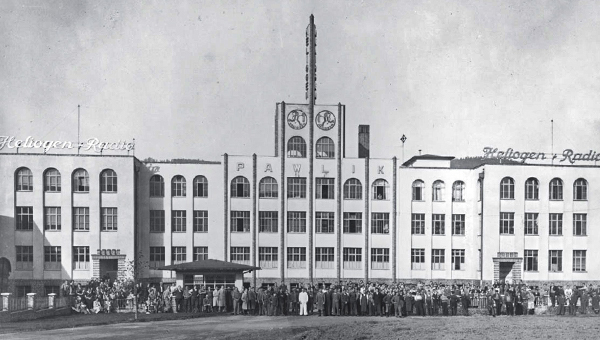
Image: ATTB historical archive · Dating: Volker Taubert archive.
A history shaped by the way we receive and share signals.
Before digital television and Internet Protocol networks, reliable reception depended on electrical components, aerials and the equipment between an antenna and a receiver. BLANKOM’s heritage reaches back to that world: to the Heliogen factory founded by Hermann Pawlik in Königsee, and to the generations of people who developed communications technology in Bad Blankenburg.
The following history follows those industrial roots through changing ownership, company names and technologies. The present BLANKOM brand belongs to IRENIS GmbH in Nordstemmen. Its history includes predecessor businesses and related engineering traditions; the legal entities and individual product ranges changed over time.
Königsee &
Bad Blankenburg
Hermann Pawlik and the Heliogen factory
BLANKOM traces its origins to the establishment of Hermann Pawlik – Elektrotechnische Fabrik Heliogen in Königsee, Thuringia, in 1919. Pawlik worked with Rudolf Roehler, a porcelain manufacturer and his father-in-law. Electrical trade and small components formed the starting point for a business that would grow with radio.
The young company moved to Bad Blankenburg in 1921, initially occupying the former “Kühler Grund” inn. The move tied its development to the town whose name later became part of BLANKOM’s identity. Between 1929 and 1932, a substantial factory building was constructed in Bahnhofstraße, opposite the railway station.
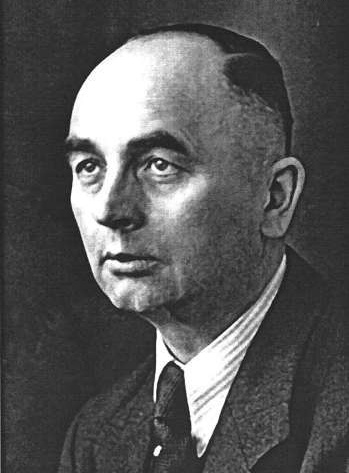
Undated portrait · Archive Volker Taubert, reproduced in the 2019 centenary article.
From electrical parts to radio reception
The Heliogen name became associated with radio and the components used to receive it. The historical material assembled for this account describes detector receivers, coils, tuning capacitors and antenna accessories: products from an era in which receivers were often assembled, adapted and improved component by component.
The factory photograph captures more than the building. The workforce assembled outside its façade shows the scale the business had reached by the mid-1930s. The Heliogen-Radio signs and the Pawlik name connect the architecture directly to its original purpose.

Archive Volker Taubert.
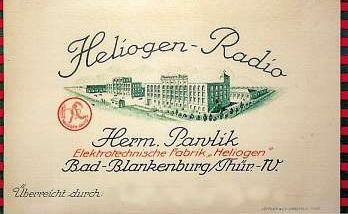
Archive Volker Taubert.
Sources: Company profile ↗ · 2019 centenary article ↗
Fernmeldewerk
& the RFT period
A new organisation for a changing communications industry
The end of the Second World War brought a decisive change of ownership. The business was expropriated in 1945 and operated as a Soviet joint-stock company, or SAG, during 1946–1949. BLANKOM’s corporate history dates the transition into the state-owned RFT – VEB Fernmeldewerk Bad Blankenburg to 1950.
The Thuringian State Archive records a subsequent formal milestone: the factory’s registration as a Volkseigener Betrieb, a publicly owned enterprise, at the Rudolstadt district court on 15 August 1952. The distinction between a change of operation and a later registry entry helps explain the different dates encountered in historical accounts.
Radio and television create new requirements
As FM broadcasting and television expanded, receiving equipment had to develop with them. The archive records the start of FM radio antenna production in 1953 and television antenna production in 1955. Antenna performance, amplification and the distribution of signals to more than one receiver became increasingly important parts of the factory’s work.
This period connects the early radio-component business with the later Antennenwerke. It also establishes a recurring technical theme in BLANKOM’s history: receiving a signal in one form, conditioning it and making it available to the people or systems that need it.
Sources: Company profile ↗ · Thuringian State Archive ↗
VEB Antennenwerke
Bad Blankenburg
Antenna engineering and familiar names in radio
On 30 June 1961, the enterprise took the name VEB Antennenwerke Bad Blankenburg. Antenna systems and related electronics became central to its identity. The 2019 centenary account describes a business with more than 1,000 employees, making it a major industrial employer in the town.
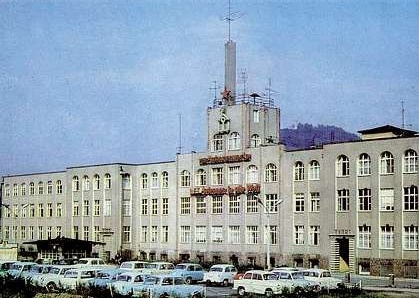
Archive Volker Taubert · W. Eckardt, centenary article, 2019 ↗
Its rooftop antennas and amplifier technology served the practical task of improving radio and television reception. The centenary account also recalls their use for long-distance reception of West German television in the GDR. This was a period when the receiving aerial, the amplifier and careful installation could determine which programmes a household could watch.
Antenna & distribution technology
The technical heritage includes receiving aerials, amplifiers and equipment for shared antenna installations. These systems brought RF engineering into homes, buildings and community reception networks, long before digital programme distribution became commonplace.
Radio & consumer electronics
The factory also made radio equipment. “Anett” and its successor “Babett” are remembered among its portable radio-cassette recorders. These products give the history a familiar domestic face alongside the professional antenna and communications equipment.
The plant became part of the VEB Kombinat Stern-Radio Berlin in December 1969. Radio production developed further in the following decades. The State Archive dates the start of Blaupunkt-licensed car radio production to 1988, near the end of the GDR period.
Sources: Thuringian State Archive ↗ · 2019 centenary article ↗
BLANKOM, headends
& IP distribution
From Antennenwerke to BLANKOM
German reunification brought another structural change. On 1 July 1990, the state enterprise was converted into a GmbH. BLANKOM’s own history identifies the name Blankenburg Communication Autoradio & Antennentechnik GmbH; the shortened BLANKOM name emerged from this new corporate identity.
Privatisation and restructuring followed during the 1990s. The State Archive records a 1993 privatisation and the name BLANKOM Kommunikationssysteme GmbH from 1997. Different activities subsequently followed different corporate paths. Today’s automotive-antenna businesses share the earlier Bad Blankenburg roots; their later ownership history is distinct from the BLANKOM broadcast-equipment brand continued by IRENIS.
Two strands of headend expertise
The BLANKOM corporate archive describes both BLANKOM Antennentechnik and BLANKOM-DIGITAL. The latter, based in Bad Salzdetfurth near Hildesheim and later renamed HILKOM-Digital, came from the FUBA headend department through General Instrument and Motorola BCN Deutschland. It contributed experience in ASI interfaces, DVB-to-IP streaming and equipment for cable operators and broadcasters.
These technologies marked a shift from distributing individual analogue services to handling digital transport streams. Reception, decoding, multiplexing, modulation and streaming could be combined in increasingly compact systems. Broadcast signals and IP networks became parts of the same headend architecture.

B-NOVA and the digital headend generation
The original B-NOVA documentation describes a modular platform with six processing and interface slots in a 1RU chassis. Its internal IP architecture allowed different modules to work together in compact IPTV and cable-TV headends, with systems expandable across multiple chassis.
The 2014/15 brochure records the wider portfolio around that period: QAMOS transmodulators, PALIOS equipment for analogue distribution, EMA encoders, optical transmission and modular headend platforms. It is a useful snapshot of the coexistence of analogue, DVB and IP technologies.
These are historical product references. The original documents remain valuable for understanding installations and the development of the range; current product pages describe today’s equipment.
Read the 2014/15 brochure ↗
Explore the original B-NOVA brochure ↗
Sources: BLANKOM corporate archive ↗ · Thuringian State Archive ↗ · BLANKOM 2014/15 brochure ↗ · B-NOVA technical brochure ↗
BLANKOM
by IRENIS
A historic brand. A new chapter in Nordstemmen.
In 2017, IRENIS GmbH acquired the BLANKOM brand and its rights. Based in Nordstemmen, in the Hannover region of Germany, IRENIS became the home of the brand’s next chapter. Its German corporate history records the introduction of a new DVB and IPTV headend range in May that year.
The change continued the BLANKOM name while establishing a new product and service organisation. IRENIS describes itself as an engineering and trading company with an international network of distribution and technical support partners. The company’s name stands for In Room Entertainment & Network Information Systems.
From a headend to a connected video network
Today, the range covers professional video encoders and IP streamers, receiving and decoding equipment, DVB-to-IP gateways, modulators and headend systems. Satellite multiswitches, optical signal transport and connectivity products extend the range around the video network.
The portfolio now spans more than 100 products. Across BLANKOM’s history, more than 10,000 headends have been installed worldwide. Experience from those installations, together with feedback from operators whose systems remain in service, continues to inform today’s products and support.
Support and system design remain part of the offer: commercial IPTV and DVB headends, enterprise video distribution, OTT projects and video over IP. The emphasis on long service life, dependable operation and value carries the brand’s practical communications focus into today’s networks.
Sources: Company profile ↗ · BLANKOM corporate archive ↗
Archive photographs, documents & further reading
The story brings together our company history, a privately compiled historical dossier, public archival records and original technical publications. The photographs above show the actual founder and the historic Bad Blankenburg factory.
The BLANKOM account
The corporate profile and German historical archive connect the brand’s early roots to its present home at IRENIS.
Factory, people & milestones
The State Archive holds the VEB Antennenwerke collection, reference 5-94-2550. The 2019 centenary article reproduces photographs from the Volker Taubert archive.
Thuringian State Archive ↗Centenary article & photographs ↗Factory chronicle, March 2011 ↗
Technology in its own time
Original BLANKOM documents illustrate the move towards modular digital headends and IP-based signal processing.
Historical dates & image credits
Founding year: 1919. BLANKOM’s company profile gives May 1919, while the centenary article gives 1 December 1919 for the Pawlik–Roehler founding. The narrative therefore uses the year without selecting an unverified exact day. The 1950 state-enterprise transition and the 1952 registry entry are identified separately. Blaupunkt-licensed production is dated to 1988 in the State Archive.
Factory photograph with workforce, c. 1935: ATTB historical archive; dating corroborated by the Volker Taubert archive. Portrait of Hermann Pawlik, letterhead c. 1919, 1930s business card and 1960s factory photograph: Archive Volker Taubert, reproduced by W. Eckardt in the 2019 centenary article. The portrait has no date specified in that source. Brochure cover: BLANKOM 2014/15 publication. Images retain their original appearance. Sources are acknowledged in the captions and image credits.
This page follows the BLANKOM brand and its industrial predecessors. It does not equate IRENIS GmbH with an unchanged legal entity operating since 1919, or merge the later history of the separate automotive-antenna business into the BLANKOM brand history.
