
Broadcast Contribution: A Practical Commissioning Checklist
Commission a source-to-studio video link with a clear interface matrix, transport checks, audio verification and a documented handover.
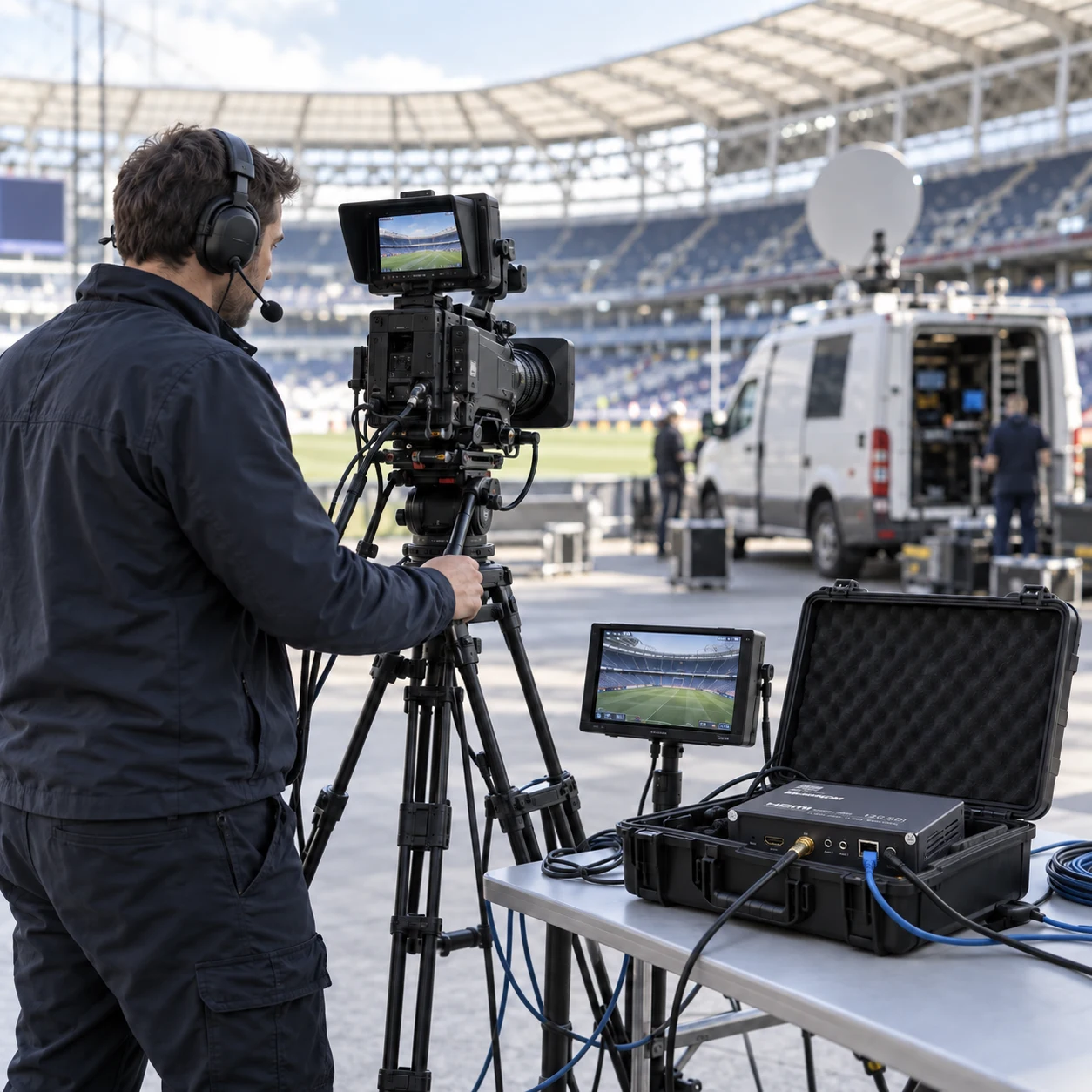
Define the handover at each end
A contribution link is ready when the receiving team can use the pictures and sound in its intended workflow. A network connection or a decoder status marked “locked” is only part of that result. Start by agreeing exactly what leaves the source and what must arrive at the destination.
Name the source device, encoder, network handover, receiver and downstream equipment. Identify who owns each part of the chain and who can change its settings. This avoids troubleshooting a network fault when the actual mismatch is at a video or audio interface.
Build the compatibility matrix
| Item | Source / sender | Receiver / destination |
|---|---|---|
| Physical interface | Connector and source output | Required output to the production system |
| Video | Resolution, frame rate, scan format | Accepted input formats and any conversion |
| Encoding | Codec, profile, level and bitrate settings | Supported decoding configuration |
| Audio | Codec, channels, sample rate and mapping | Decode support and output channel assignment |
| Transport | Protocol, packaging, addressing and ports | Matching transport and stream selection |
| Operations | Versions, management access and alarms | Monitoring, recovery and acceptance owner |
Record exact values rather than writing only “HD”, “4K” or “IP”. When the downstream workflow requires captions, ancillary data, reference signals or particular timing behaviour, list them explicitly and verify support for the selected model and firmware.
Separate media direction from connection setup
In SRT caller/listener operation, the caller initiates the connection to the listener. That role does not by itself determine which endpoint sends the video. The SRT protocol documentation describes the connection handshake.
Draw the media direction and the connection roles separately. Confirm that the agreed port is reachable, that any address translation is understood, and that the listener is available before beginning the test. Record the actual stream identifier and encryption configuration where used.
On RTP links, sequence numbers and timestamps help the receiver interpret the stream. RTP alone does not guarantee delivery, reserve bandwidth or provide a packet-recovery service. Assess the network and any additional protection required by the selected equipment. See the RTP specification, RFC 3550.
Commission in stages
- Confirm the source. Check the actual output format with appropriate monitoring equipment. Verify embedded audio channel assignments.
- Build a local loop. Connect the intended encoder and receiver on a controlled network. Save the working settings before adding the external path.
- Add the contribution network. Observe stream rate, network errors and recovery behaviour while watching and listening at the destination.
- Check the downstream handover. Confirm the output on the production equipment itself, including the required video timing and audio mapping.
If the result fails, return to the last working stage and change one variable. Keep a known-good source and receiver configuration available so that troubleshooting does not depend on several unverified settings at once.
Make picture, sound and recovery part of acceptance
Use a test sequence that includes motion, fine detail, dark areas and transitions. Listen to every required audio channel. Check lip synchronisation against a suitable visual and audible event, using the same measurement method for all configurations.
Agree the required test duration and representative network load with the operator. Log interruptions, format changes and alarms. In a controlled test, restart a source or interrupt the link and record whether service resumes automatically and what the operator sees during recovery.
If redundancy is required, test the planned switchover with the actual system. Document whether a disturbance occurs; the presence of a backup path does not establish a seamless changeover.
Hand over a configuration that can be reproduced
The handover pack should include the compatibility matrix, a connection drawing, device and firmware versions, saved configurations, network ownership, acceptance results and the recovery procedure. Store credentials separately with the authorised operator.
Keep the scope clear: a receiver, an encoder, an audio receiver and an ASI/IP gateway serve different stages of a chain. Select the needed function first, then confirm the exact model’s supported inputs, outputs and stream formats. A familiar protocol name does not replace that compatibility check.
Practical questions
Does an SRT caller have to be the video sender?
No. Caller and listener describe connection setup. Confirm the media direction independently for the encoder and receiver.
Why can a connected stream still produce no picture?
A successful connection does not establish that the codec, profile, packaging or selected service is compatible with the receiver. Check the media configuration and the receiver’s supported formats.
What belongs in a contribution link quotation request?
Include the source and output interfaces, exact video and audio formats, channel count, network and transport requirements, recovery expectations and the intended receiver.
Specify your contribution link
Share the source-to-destination matrix and the interfaces your production workflow requires.
