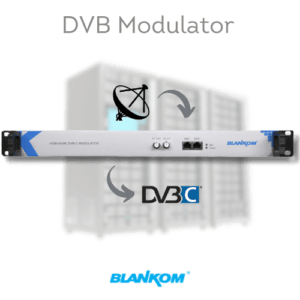

Low Latency Modulator with 8-12 SDI Inputs
The BLANKOM HDM-12220 and HDM-08220 HD Encoder/Modulators are a fully integrated, carrier-grade platform designed for modern broadcast, IPTV, and Headend deployments.
At a glance
Key data, as supplied by engineering- 12 or 8 HD-SDI Inputs
- 16 DVB-C carriers (8 DVB-T/ATSC, 6 ISDB-T carriers)
- Multiplexer
- 1 ASI output
- 1 RF input (DVB-C or ATSC tuner)
Overview
Product description
The BLANKOM HDM-12220 and HDM-08220 HD Encoder/Modulators are a fully integrated, carrier-grade platform designed for modern broadcast, IPTV, and Headend deployments. Combining encoding, multiplexing, scrambling, and RF modulation in a single high-density chassis, it delivers exceptional efficiency and flexibility for multi-channel operations.
Key Features
-
12/8 × HD-SDI Inputs with Closed Captioning
Supports 12 or 8 HD-SDI sources, each with embedded or external CC, providing robust ingest for professional broadcast environments. -
Multi-Source Input Architecture
-
1 × DVB-C tuner input
-
Up to 512 IP streams via Data1 (GE) port
Enables hybrid workflows and seamless integration into existing headends.
-
-
Advanced Output Modulation
-
DVB-C RF output: up to 16 non-adjacent carriers
-
DVB-T RF output: up to 8 non-adjacent carriers
Ideal for cable and terrestrial distribution networks requiring multi-carrier delivery.
-
-
MPTS Mirroring Over IP
-
16 MPTS mirrored for DVB-C mode
-
8 MPTS mirrored for DVB-T mode
Delivered via Data2 (GE) for reliable IP backbone distribution.
-
-
ASI Output
One ASI output is available as a real-time mirror of any selected MPTS, offering maximum interoperability with legacy systems.
Low Latency Modulator with 12 or 8 HD-SDI Inputs, DVB-C, DVB-T, ISDB-T, or ATSC Outputs
BLANKOM HDM-08220 and HDM-12220 are high-integration professional modulators that combine encoding, multiplexing, and modulation into a single unit. Available for all common modulation standards, it has several input and output combinations. Besides the HD-SDI inputs, the signals can also be fed through the IP, ASI and USB inputs. All the available content can be multiplexed into several packets and modulated into RF carriers.

BLANKOM HDM-12220C QAM Modulator (DVB-C Modulator)
Key Features
1. High-Density Input Architecture
-
- Physical Video/Audio: Equipped with 8 or 12 × HD-SDI/SD-SDI inputs featuring full support for Closed Captioning (CC) metadata pass-through. Note: While the frame houses up to 12 physical SDI ports, users can optionally license or configure it for 8-channel operation depending on headend requirements.
- Network Stream Ingest: 512 × IP inputs over UDP and RTP protocols via the DATA 1 Gigabit Ethernet (GE) port. Each active output RF carrier is capable of multiplexing up to 32 independent external IP transport streams.
- Tuner-based Re-Muxing: Includes 1 × DVB-C tuner input (ATSC optional) natively on the motherboard to ingest and remux existing cable/terrestrial channels with the local SDI encodes.
2. Dual-Codec Video & Audio Compression
-
- Video Codecs: Natively supports both MPEG-2 (for legacy televisions) and MPEG-4 AVC / H.264 video compression.
- Resolution Processing: Ingests standard and high-definition SDI feeds:
-
- Inputs: 1080p @50/60, 1080i @50/60, 720p @50/60, 576i, 480i.
- Outputs: Rescales or matches streams dynamically up to 1080p @25/30, 1080i @50/60, and standard definition formats.
-
- Audio Encoding Engine: Supports standard broadcast audio layers including MPEG-1 Layer II, MPEG2-AAC, MPEG4-AAC, and optional Dolby Digital AC3 (2.0) encoding alongside AC3 (2.0/5.1) raw pass-through.
3. Modulation Specifications (DVB-C vs. DVB-T)
| Modulation Metric | DVB-C Modulation | DVB-T Modulation |
|---|---|---|
| Carrier Capacity | 16 non-adjacent carriers | 8 non-adjacent carriers |
| Multiplex Groups | 16 independent Mux/Scrambling blocks | 8 independent Mux blocks |
| Broadcast Standard | J.83A (Europe), J.83B (USA) | ETSI EN 300 744 |
| Constellations | 16 / 32 / 64 / 128 / 256 QAM | QPSK, 16QAM, 64QAM |
| Transmission Mode | N/A | 2K and 8K COFDM |
| Guard Intervals | N/A | 1/4, 1/8, 1/16, 1/32 |
| Frequency Range | 50 MHz to 960 MHz (1 kHz steps) | 50 MHz to 960 MHz (1 kHz steps) |
| Output Integrity | Clean RF distribution, MER ≥ 42 dB | Clean terrestrial distribution, MER ≥ 42 dB |
4. Concurrent Network Stream Outputs
-
- IP Mirror Output: Features a dedicated DATA 2 Gigabit Ethernet (GE) port used strictly to mirror the RF spectrum over the network.
-
- In DVB-C mode, it outputs 16 × MPTS streams.
- In DVB-T mode, it outputs 8 × MPTS streams.
-
- ASI Legacy Mirroring: Features 1 × physical ASI output (BNC) that can be software-configured to mirror any single chosen MPTS/RF carrier block for external equipment routing.
- IP Mirror Output: Features a dedicated DATA 2 Gigabit Ethernet (GE) port used strictly to mirror the RF spectrum over the network.
5. Software & Stream Processing Utilities
- PID & Table Customization: Complete manual manipulation over PSI/SI tables (PAT, PMT, NIT, SDT editing), accurate PCR adjustments, and structural PID remapping.
- Scrambling Capabilities: The DVB-C profile natively supports standard DVB scrambling for pay-TV conditional access systems.
- System Management: Maintained remotely using an English or Chinese standard Web-GUI via a dedicated RJ45 network management port.
Features & capabilities
- 12× or 8× HD-SDI Inputs
- MPEG-2 and MPEG-4 AVC/H.264 video encoding with embedded audio and CC support.
- 1× DVB-C (ATSC optional) tuner input for re-multiplexing applications.
- High-Capacity IP Ingest
- Each carrier output channel can process up to 32 IP streams from the DATA1 GE port (UDP/RTP protocols).
- Flexible Audio Encoding & Passthrough
- MPEG1 Layer II, MPEG2-AAC, MPEG4-AAC, Dolby Digital AC3 (2.0) encoding (optional), AC3 (2.0/5.1) passthrough.
- Multi-Standard Modulation
- DVB-C: 16 multiplexing/scrambling/modulation groups
- DVB-T/ATSC: 8 multiplexing/modulation groups (optional)
- ISDB-T: 6 multiplexing/modulation groups (optional)
- 1 × ASI output as a mirror of any selected RF output carrier.
- High-Density MPTS Output Over IP (DATA2 Port)
- 16 MPTS over UDP/RTP/RTSP for DVB-C mode
- 8 MPTS over UDP/RTP/RTSP for DVB-T/ATSC
- 6 MPTS over UDP/RTP/RTSP for ISDB-T
- Advanced Transport Stream Processing
- PID remapping, accurate PCR correction, PSI/SI table editing and insertion.
- Intuitive Management
- Web-based GUI for configuration, monitoring, and firmware upgrades.
Front and rear panels
Front and Rear Panels
BLANKOM HDM-12220C QAM Modulator (DVB-C Modulator) front panel

BLANKOM HDM-12220C QAM Modulator (DVB-C Modulator) rear panel
System & application diagrams
Typical deploymentSystem Diagram
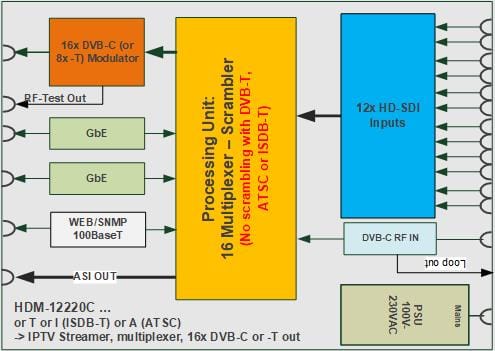
Application Diagram

Technical specifications
Specifications are subject to change without prior noticeTechnical Specifications
Function: DVB Modulator
Technical Specifications
Input
• 12× or 8× HD-SDI with Closed Caption
• 1 × DVB-C tuner (ATSC optional), F-type
• Up to 512 IP streams (UDP/RTP, DATA1, RJ45) – DVB-C
• Up to 256 IP streams (UDP/RTP, DATA1, RJ45) – DVB-T/ATSC
• Up to 192 IP streams (UDP/RTP, DATA1, RJ45) – ISDB-T
Video
• Input Resolutions: 1080p60/50, 1080i60/50, 720p60/50, 480i60, 576i50
• Output Resolutions: 1080p/i, 1440×1080i, 1280×720p, 720×576p/i, 720×480p/i, 320×240, 320×180, 960×540i, 704×576i, 704×480i, 640×576i, 640×480i, 544×576i, 544×480i
• MPEG-2 & MPEG-4 AVC/H.264 encoding
• Bitrate: 0.8–19 Mbps (H.264), 1–19 Mbps (MPEG-2)
• Rate Control: CBR / VBR
• GOP: B-frames 0–3, P-frames 0–6
• Processing: De-interlacing, noise reduction
Audio
• MPEG-1 Layer II, MPEG-2 AAC, MPEG-4 AAC
• Dolby Digital AC-3 (2.0) encoding (optional)
• AC-3 (2.0/5.1) passthrough
• 48 kHz sampling, 64–320 kbps
Multiplexing/Processing
• Up to 256 PIDs per channel
• PID remapping (auto/manual)
• Accurate PCR adjustment
• PSI/SI table generation
Scrambling
• Up to 4 SimulCrypt CA systems
• Standards: ETR289, ETSI 101197, ETSI 103197
• Local/remote management
RF Modulation
DVB-C
• 16 non-adjacent carriers (up to 192 MHz)
• EN 300 429 / ITU-T J.83 A/B
• MER ≥ 40 dB
• 50–960 MHz (1 kHz step)
• Output: –20 to +10 dBm (0.1 dB step)
• SR: 5.0–7.0 Msps
• QAM: 16/32/64/128/256 (A), 64/256 (B)
DVB-T
• 8 non-adjacent carriers (192 MHz)
• EN 300 744
• FFT: 2K / 4K / 8K
• Bandwidth: 6/7/8 MHz
• QPSK / 16QAM / 64QAM
• GI: 1/4 / 1/8 / 1/16 / 1/32
• FEC: 1/2–7/8
• MER ≥ 42 dB
• –20 to +10 dBm (0.1 dB step)
ATSC
• 8 non-adjacent carriers
• ATSC A/53
• 6 MHz bandwidth
• 8VSB
• FEC: RS(208/188)+Trellis
• MER ≥ 40 dB
• ACL: –55 dBc
• –20 to +10 dBm (0.5 dB step)
ISDB-T
• 6 non-adjacent carriers
• ARIB STD-B31
• 6 MHz bandwidth
• QPSK / 16QAM / 64QAM
• GI: 1/32 / 1/16 / 1/8 / 1/4
• 2K / 4K / 8K modes
• Code rate: 1/2–7/8
• MER ≥ 40 dB
• –20 to +10 dBm (0.1 dB step)
Stream Output
• 1 × ASI output, mirror of any RF carrier
• 16 × MPTS over UDP/RTP/RTSP (DVB-C mode)
• 8 × MPTS over UDP/RTP/RTSP (DVB-T/ATSC, optional)
• 6 × MPTS over UDP/RTP/RTSP (ISDB-T, optional)
• 1 × 1000M Ethernet (Base-T)
System
• Web-based management
• English User Interface
• Firmware upgrade via web
General
• Size: 482 × 440 × 44 mm
• Operating Temp: 0–45°C
• Storage: –20–80°C
• Power: AC 110V±10% / AC 220V±10%, 50/60 Hz
Specifications are subject to change without prior notice.
Ordering guide
Exact part numbers for the quotationOrdering guide
Engineering questions
10 questions answered by the people who commission these unitsFAQ (Frequently Asked Questions)
What are the physical input channel options available for this low-latency SDI modulator series?
To accommodate different project scales and density requirements, this professional modulator series is available in two distinct hardware configurations: an 8-channel HD-SDI input model and a high-density 12-channel HD-SDI input model. Both variants are housed in a compact, robust 1U rack-mountable chassis, optimizing space in server rooms and broadcast headends.
Which digital RF modulation standards are supported at the output stage?
The device features a flexible, software-configurable RF up-converter output. It can be ordered or configured to output either DVB-T (COFDM) for terrestrial distribution layouts or DVB-C (QAM) for digital cable television networks. This dual-output versatility ensures seamless integration into standard coaxial distribution infrastructures worldwide.
What makes this SDI modulator suitable for time-critical applications like live sports or studio monitoring?
By eliminating buffer overheads through a hardware-driven encoding core, it achieves an ultra-low glass-to-glass delay. It delivers a carrier-grade low-latency window under 200–300 milliseconds, maintaining tight synchronization for live sports and stadium-wide video distribution.
Can the device output multiple adjacent RF carriers, and how does it optimize the spectrum?
Yes, the internal digital multiplexer allows the generation of multiple adjacent RF carriers simultaneously. Depending on the input load (8 or 12 channels) and bitrate settings, the processed HD-SDI signals are multiplexed efficiently into a high-density RF block. This approach provides a superior Modulation Error Ratio (MER) value, drastically reducing the need for external active combining networks and maximizing coaxial spectrum efficiency.
What video compression standard and resolution limits are supported by the encoding engine?
The hardware encoding matrix utilizes professional H.264/AVC (MPEG-4) video compression to maintain broad compatibility with standard digital TV tuners and corporate HD Set-Top Boxes. It accepts uncompressed broadcast-grade digital inputs up to 1080p at 60 frames per second (1080p60), providing individual bitrate adjustments (CBR/VBR) per channel to match precise network bandwidth constraints.
Does the modulator extract embedded audio from the HD-SDI streams?
Yes, the device automatically detects and extracts the embedded digital audio tracks paired within each incoming HD-SDI coaxial signal. The audio layer is compressed using industry-standard MPEG-1 Layer II (MP2) or AAC audio layers, ensuring robust synchronization and broadcast-standard digital sound quality across all modulated RF output channels.
Are advanced multiplexing features like LCN (Logical Channel Numbering) supported?
Yes, the integrated PSI/SI (Program Specific Information / Service Information) table editor gives operators full control over the digital multiplex metadata. It natively supports LCN (Logical Channel Numbering), which allows the pre-definition of the exact channel order and numbers assigned on end-user television screens. It also supports PID Remapping, Service Name configuration, and Provider ID editing.
How is the system managed and monitored by network administrators?
The modulator features a dedicated Network Management System (NMS) Ethernet interface. Operators can configure, tweak, and monitor all parameters—including input status, encoding bitrates, output frequencies, and RF attenuation levels—via an intuitive, responsive browser-based WebGUI. Additionally, SNMP support is integrated for centralized industrial network monitoring and automatic alert handling.
What is the reliability profile of the device for continuous 24/7 commercial operations?
Enclosed in a ruggedized 1U metal chassis with automated thermal management, this broadcast infrastructure equipment is designed for high availability for 24/7/365 heavy-duty environments.
Are technical data sheets and ordering guides available for the different hardware models?
Yes, comprehensive technical PDF Datasheets outlining all technical parameters are directly accessible on irenis-blankom.com. Furthermore, due to the modular design variations (8 vs. 12 SDI ports and DVB-T vs. DVB-C suffixes), an explicit Ordering Guide table is included on the page to help system integrators and purchasing managers select the exact model suffix required for their project architecture.
Downloads
Downloads, Links

Get a quote for the HDM-12220 series
Tell us the source, the destination and the number of channels. We reply in writing with a configuration, part numbers and pricing — our engineers answer from the bench, so a written enquiry reaches the right person faster than a phone call.