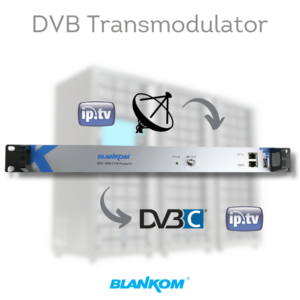

DVB Transmodulator with DVB-S2 Input, 16 Tuner
BLANKOM HDC-7016A is a 5th generation SAT & IPTV to QAM (DVB-C) Transmodulator with multiplexer and scrambler. The IPTV input channels can be SPTS or MPTS, unicast or multicast.
At a glance
Key data, as supplied by engineering- 16x DVB-S/S2/S2X Tuner Inputs (L, KU, C-Band)
- (DVB-C/T/T2/ISDB-T/ATSC-T optional)
- Up to 128 IP Inputs (SPTS/MPTS) via GbE
- 2x ASI Inputs
- 1x TS Playing via USB Disk
- 16x Non-adjacent DVB-C QAM RF Outputs
- 16x MPTS IP Outputs over UDP/RTP
- 2x ASI outputs (2x TS as mirror)
- 16 groups multiplexing
- 16 groups scrambling (optional)
- 16 groups QAM modulating
Overview
Product description
BLANKOM HDC-7016A is a 5th generation SAT & IPTV to QAM (DVB-C) Transmodulator with multiplexer and scrambler.
The IPTV input channels can be SPTS or MPTS, unicast or multicast.
The internal multiplexer creates 16 RF + streams with any combination of content.
The output consists of 16 DVB-C carriers within 192 MHz bandwidth, each with up to 256QAM modulation.
Each of the 16 output multiplexes is also provided as MPTS IPTV streams, UDP/RTP/RTSP, unicast or multicast at both the data ports.
QAM (DVB-C) Transmodulator with DVB-S/S2 & IPTV Input, 16 Tuners for 16 Satellite Transponders
5. Generation BLANKOM DVB-C Headend Technology. Satellite and IPTV input, DVB-C output, with Multiplexer.
The content of the individual DVB-C packages can be freely configured from all available input channels. The device can be operated from anywhere on a LAN, WAN, or the Internet.

BLANKOM HDC-7016A Transmodulator
Features & capabilities
Features
BLANKOM HDC-7016A is a high performance and cost-effective QAM Transmodulator.
The unit has 16 DVB-S/S2 FTA tuner inputs, 16 groups multiplexing, 16 groups scrambling, 16 groups QAM modulating, and supports a maximum of 512 IPTV inputs through the GE port and 16 adjacent carriers (50 MHz~960 MHz) combined output through the RF output interface.
BLANKOM HDC-7016A is also characterized by a high level of integration, high -performance, and low cost. They support dual power supply (optional). This is very adaptable to new generation CATV Headend systems.
- 16 Channel DVB-C (QAM) Headend System
- 16 DVB-S/S2 tuner inputs for FTA satellite transponders
- 512 IPTV inputs (UDP, RTP)
- 2 ASI inputs
- 16 groups multiplexing + 16 groups scrambling
- 16 groups QAM modulating
- Excellent RF output performance index, MER ≥ 40 dB
- Accurate PCR adjusting
- PSI/SI editing and inserting
- Web management, updates via web
- DiSEqC 1.0 LNB control for up to 4 satellites
- Dual power supply (optional)
Front and rear panels
Front and Rear Panels
BLANKOM HDC-7016A Transmodulator front panel

BLANKOM HDC-7016A Transmodulator rear panel
System & application diagrams
Typical deploymentSystem Diagram

Application examples
Applications
All in one Headend unit for SMATV systems in residential blocks, hotels, offices, etc.
Application Example

Technical specifications
Specifications are subject to change without prior noticeTechnical Specifications
FUNCTION
16 channel DVB-C Headend with satellite and IPTV input
INPUT
- 16 DVB-S/S2 FTA Tuner
- 512 IPTV channels over UDP and RTP protocol
- 2 ASI
OUTPUT
- 16 DVB-C groups that can be multiplexed from any combination of input channels
Tuner section:
- 16 DVB-S/S2 tuners with input frequency range: 950-2150 MHz
- Symbol rate: 2-45 MSps (supports SCPC and MCPC)
- Signal strength: -65~-25dBm
- Supports QPSK, 8PSK; supports DiSEqC 1.0 LNB control for up to 4 satellites
Multiplexing
- 16 multiplexers, maximum PID remapping: 128 per input channel
- PID remapping (automatically or manually), accurate PCR adjusting, and generating PSI/SI tables automatically
Scrambling
- Max simulscrypt CA: 4
- Scramble Standard: ETR289, ETSI 101 197, ETSI 103 197
Local/remote connection
Modulation
- 16 DVB-C (QAM) channels, Standard EN300 429/ITU-T J.83A/B
- RF frequency 50~960 MHz, 1 kHz step
- RF output level 77~97 dBµV, 0.1 dB step
- Constellation 16/32/64/128/256QAM
- MPTS / SPTS over UDP, 10/100 Base-T Ethernet interface (UDP unicast/multicast)
SYSTEM
- Control: Remote management Web NMS(10M/100M)
GENERAL
- Dimensions: 482 mm × 300 mm × 44.5 mm, 19” 1 RU, 3.7 kg
- Power: AC 110V±10%, 50/60Hz or AC 220V±10%, 50/60Hz, 25 W, dual power supply optional
- Temperature: 0~45℃ (operation), -20~80℃ (storage)
Specifications are subject to change without prior notice.
Ordering guide
Exact part numbers for the quotationOrdering guide
Engineering questions
10 questions answered by the people who commission these unitsFAQ (Frequently Asked Questions)
What is the primary operational function of the BLANKOM 16-Tuner DVB-S2 to DVB-C Transmodulator?
This high-density professional transmodulator is designed to receive digital satellite signals across 16 independent DVB-S/S2 transponders and modulate them directly into standard DVB-C (QAM) Radio Frequency (RF) channels. This allows cable operators to convert extensive satellite channel lineups for seamless distribution over existing local or regional coaxial cable networks.
Does the device feature physical Common Interface (CI) slots for commercial Pay-TV descrambling?
No. This specific 16-tuner transmodulator model is engineered strictly as a high-density Free-to-Air (FTA) optimization gateway. It omits physical CI slots to maximize tuner input density and multiplexing throughput within a compact 1U framework. For setups requiring hardware-based CAM decryption, specialized BLANKOM multi-CI modules must be deployed in the headend topology instead.
How many independent DVB-C QAM RF output carriers can be generated by this 16-tuner unit?
To efficiently process and distribute the high-density payload ingested from the 16 satellite transponders, the advanced digital modulation engine of the HDC-7016A is engineered to generate exactly 16 independent QAM RF carriers simultaneously. This configuration allows operators to bundle and broadcast extensive multiplexed digital TV and radio lineups over a single coaxial physical distribution network with optimal bandwidth allocation.
Does this transmodulator feature an integrated multiplexing core, or is it a transparent pass-through device?
The unit incorporates a powerful internal digital multiplexer. Unlike basic transparent pass-through loop converters, it enables headend engineers to demultiplex incoming satellite transport streams, perform selective PID filtering or PID remapping, and freely recombine elementary video and audio streams from different satellite tuners into custom-tailored QAM output carrier packages.
Which QAM constellation standards and symbol rates are supported by the integrated modulator?
The digital modulation layer complies strictly with ITU-T J.83A and J.83B digital cable specifications. It supports 16QAM, 32QAM, 64QAM, 128QAM, and 256QAM constellations with an adjustable symbol rate up to 7.0 Msps per carrier, ensuring reliable tuning across standard digital television sets and legacy edge set-top boxes.
What is the RF output frequency range and signal quality metric of the transmodulator?
The device incorporates an agile RF output section covering the standard digital cable television spectrum from 48 MHz up to 860 MHz. It features a high-performance modulation circuit that ensures a superior MER (Modulation Error Ratio) and exceptionally low phase noise, preventing signal degradation or pixelation across extensive coaxial trunk lines.
Can the transmodulator parse, edit, and regenerate PSI/SI transport stream metadata tables?
Yes, full PSI/SI table parsing and regeneration are natively executed by the internal multiplexer engine. The unit automatically processes and rebuilds PAT, PMT, NIT, and SDT metadata tables. This grants operators the flexibility to manually customize service names, provider identifiers, and Logical Channel Numbering (LCN) directly via the configuration layout.
Does the device support embedded software-based BISS decryption for secured satellite feeds?
Yes. Despite being an FTA gateway without physical CI/CAM module slots, it features embedded software-assisted BISS (Basic Interoperable Scrambling System) Mode 1 and Mode E decryption. Headend engineers can input hexadecimal keys directly via the administrative interface to decode secured satellite contribution transport feeds.
How is remote management implemented for this high-density transmodulator? Is SNMP supported?
Remote configuration, real-time bit-rate analysis, tuner locking margins, and RF signal configuration are managed exclusively via an embedded WebGUI through a standard internet browser over a dedicated, independent Ethernet management interface. This model line does not support SNMP management, ensuring a highly secure, lightweight, and low-overhead administration environment.
What chassis form factor and power reliability configurations are engineered for continuous commercial uptime?
Housed in a rugged standard 19-inch 1U rack-mount industrial metal enclosure, the unit is engineered for demanding 24/7/365 commercial headend uptimes. It relies on intelligent active cooling fans for thermal stability and can be provisioned via our technical Ordering Guides with dual redundant power supplies to protect the distribution path against primary AC power line failures.
Downloads
Downloads, Links

Get a quote for the HDC-7016A
Tell us the source, the destination and the number of channels. We reply in writing with a configuration, part numbers and pricing — our engineers answer from the bench, so a written enquiry reaches the right person faster than a phone call.