
ASI to IP Gateway and Multiplexer (bidirectional)
Overview The BLANKOM IGA-4400 is a highly versatile, broadcast-grade bidirectional ASI to IP gateway, IP to ASI gateway, IP multiplexer, and ASI multiplexer engineered for digital TV headend systems.
At a glance
Key data, as supplied by engineering- 4x Bi-directional ASI ports (ASI direction can be defined as input or output manually)
- 768x IP inputs over UDP/RTP in total (256x IP inputs through GE1, GE2 and DATA port respectively)
- 4x Bi-directional ASI ports (ASI direction can be defined as input or output manually)
- 4x IP (MPTS) out over UDP/RTP through GE1, GE2 and DATA port
- IP to ASI Converter (Gateway)
- ASI to IP Converter (Gateway)
- IP Multiplexer
- ASI Multiplexer
Overview
Product description
Overview
The BLANKOM IGA-4400 is a highly versatile, broadcast-grade bidirectional ASI to IP gateway, IP to ASI gateway, IP multiplexer, and ASI multiplexer engineered for digital TV headend systems. It serves as a critical bridge between ASI and IP domains, allowing operators to seamlessly convert transport streams in both directions while performing advanced multiplexing functions.
Equipped with 4 bidirectional ASI ports and 2 high-speed Gigabit Ethernet ports, the IGA-4400 can route and multiplex up to 4 ASI inputs and 512 IP (SPTS/MPTS) inputs into 4 distinct Multi-Program Transport Streams (MPTS) over both ASI and IP simultaneously. With its integrated web-based management interface, automatic PSI/SI generation, and highly accurate PCR filtering, the IGA-4400 delivers premium broadcasting reliability at a breakthrough price point.
ASI to IP Gateway / IP to ASI Gateway & Multiplexer
High-Performance Transport Stream Bridging: A professional, cost-effective 1U rackmount solution designed to bridge traditional ASI broadcast infrastructure with modern IP-based digital TV headend networks.

Core Features
-
True Bidirectional Operation: Effortlessly functions as an ASI to IP gateway, an IP to ASI gateway, or a hybrid of both simultaneously.
-
Flexible Port Architecture: 4 physical BNC ports can be independently configured as either inputs or outputs (Maximum 2+2 ASI inputs and 2+2 ASI outputs dynamically handled).
-
Massive IP Input Capacity: Supports up to 512 IP stream inputs over dual 100/1000M self-adaptive Ethernet interfaces.
-
Advanced Stream Processing: Features precise PCR (Program Clock Reference) accurate adjustment, PID filtering, transparent pass-through, and custom PID re-mapping.
-
PSI/SI Rebuilding: Automatically generates and edits PSI/SI (Program Specific Information / Service Information) tables to ensure complete STB and TV compatibility.
-
Network Stability: Embedded with an ultra-large buffer memory mechanism to prevent stream overflow and eliminate packet drop Jitter.
-
Carrier-Grade Management: Fully manageable locally or remotely via an intuitive web-based GUI (NMS) or via standard SNMP software.
Key Applications
-
Broadcast Headend Integration: Seamlessly bridge legacy ASI encoders, modulators, or receivers into modern IP-based distribution networks.
-
IP to ASI Conversion: Receive up to 512 SPTS/MPTS IP streams over UDP/RTP and output them through up to 4 hardware ASI ports for traditional distribution.
-
Advanced TS Multiplexing: Aggregate multiple content sources from both physical ASI inputs and network IP inputs, filter channels, re-map PIDs, and compile clean MPTS outputs.
Features & capabilities
- ASI to IP gateway and IP to ASI gateway (bi-directional)
- IP Multiplexer (SPTS IP in, MPTS IP & ASI out)
- 4 bi-directional ASI ports and 2 100/1000M ethernet ports
- Maximum 2+2 ASI inputs and 256×2 IP inputs
- Maximum 2+2 ASI outputs and 4 IP (MPTS) outputs over UDP
- Accurate PCR adjusting
- PID filtering, re-mapping
- PSI/SI rebuilding and editing
- Huge buffer memory for saving the overflowing code stream
- Multiplex the same program to all outputs possible
- Alarm function
- Web-based management
- Remote control and firmware, web NMS management
- Updates via web
- Professional quality, breakthrough price.
Front and rear panels
Front and Rear Panels

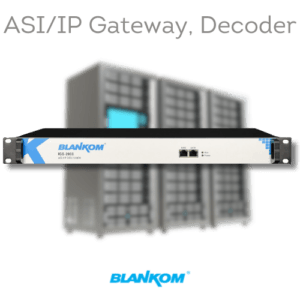
BLANKOM IGA-4400 front and rear view
System & application diagrams
Typical deploymentSystem Diagram

Application examples
Application Examples
Legacy Broadcast Headend Migration to IP Backbones
-
Scenario: A terrestrial or cable broadcasting station needs to transition its legacy hardware architecture from coaxial ASI routing to a modern, cost-effective IP core network.
-
Implementation: The IGA-4400 acts as a bidirectional bridge. It ingests up to 4 legacy ASI Multi-Program Transport Streams (MPTS) from older satellite receivers or encoders, de-encapsulates the data, and outputs up to 4 clean MPTS over UDP/RTP directly into the IP network core, allowing legacy hardware to communicate natively with IP-based edge equipment.
High-Density IP SPTS Aggregation for Regional Cable Networks
-
Scenario: A central headend receives up to 512 individual Single-Program Transport Streams (SPTS) via IP from various network encoders and needs to bundle them into a few highly organized packages for distribution.
-
Implementation: The unit utilizes its massive IP ingestion engine to process up to 512 SPTS inputs simultaneously. Using the integrated web interface, operators filter, remap PIDs, and multiplex these independent programs into 4 distinct, DVB-compliant MPTS outputs. These outputs are sent concurrently over both the Gigabit Ethernet ports and the physical ASI interfaces to feed edge QAM modulators.
PSI/SI Rebuilding and NIT Insertion for Localized Cable TV
-
Scenario: A regional cable provider ingests a generic national MPTS feed but needs to alter the virtual channel numbering, program names, and Network Information Table (NIT) to suit local regulatory and branding requirements.
-
Implementation: The IGA-4400 ingests the national feed via ASI or IP. Through its advanced internal processing layer, engineers can edit the PAT, PMT, and SDT tables, strip unwanted programs via service filtering, adjust PCR accuracy, and inject localized LCN (Logical Channel Numbering) metadata into the newly generated multiplex before delivering it to local transmission lines.
Bidirectional Teleport and Studio Interconnection
-
Scenario: A satellite teleport facility and a remote television production studio need to exchange feeds bi-directionally over an IP fiber link, requiring ASI at both ends for local hardware integration.
-
Implementation: An IGA-4400 is deployed at both sites. The 4 physical ASI ports on each device are configured dynamically (e.g., 2 as inputs, 2 as outputs). The studio converts its local ASI camera matrices into IP for transport across the fiber link, while simultaneously receiving the return feed from the teleport via IP and outputting it locally through the remaining ASI ports to monitoring blocks.
Multi-Output Program Mirroring and Redundant Distribution
-
Scenario: A broadcaster needs to feed the exact same high-priority transport stream bundle to multiple redundant physical paths and backup modulator clusters without introducing cascading delays.
-
Implementation: The IGA-4400 processes the target transport stream and leverages its “multiplex same program to all outputs” feature. It replicates the configured multiplex identically across all 4 ASI hardware ports and all 4 IP MPTS streaming destinations simultaneously, creating a perfectly synchronized hardware-and-stream redundancy layout.
Technical specifications
Specifications are subject to change without prior noticeTechnical Specifications
Technical Specifications
| Feature / Parameter | Specifications |
| Function | Bidirectional ASI to IP Gateway, IP Multiplexer |
| ASI Interfaces | 4x Bidirectional BNC ports, 75Ω (Max 2 Inputs / 2 Outputs configuration) |
| IP Interfaces | 2x 100/1000Mbps self-adaptive RJ45 Ethernet ports |
| IP Input Capacity | Up to 512 IP streams over UDP / RTP |
| Output Capabilities | 4x MPTS over UDP/RTP (IP) and up to 4x ASI (BNC) outputs |
| Max ASI Bit-rate | Up to 200 Mbps per individual channel |
| Processing Functions | PID Re-mapping, Transparent Pass-through, Service Filtering, Accurate PCR Adjusting, Auto PSI/SI Table Generation |
| Output PID Capacity | 512 PIDs per output channel |
| Stream Formats | Self-adaptive 188 / 204 byte packet lengths |
| Management & Control | Dedicated 10/100M NMS Web Interface, English UI, Web-based Firmware Upgrades |
| Chassis / Size | Standard 19-inch 1U Rackmount Unit (482mm × 300mm × 44mm) |
| Weight & Power | 3.5 kg | AC 110V/230V ±10%, 50/60Hz | Power Consumption ≤ 40W |
| Environmental Parameters | Operating Temp: 0…45°C | Storage Temp: -20…80°C |
Specifications are subject to change without prior notice.
Ordering guide
Exact part numbers for the quotationOrdering guide
Engineering questions
10 questions answered by the people who commission these unitsFAQ (Frequently Asked Questions)
How can the 4 physical ASI ports on the IGA-4400 be configured?
The 4 physical ASI ports (75Ω BNC) provide flexible hardware allocation and are manually configured in pairs (2 channels at a time) as either inputs or outputs. The permissible operating modes are:
-
2 ASI Inputs + 2 ASI Outputs
-
4 ASI Inputs (All ports acting as ingestion interfaces)
-
4 ASI Outputs (All ports acting as distribution interfaces)
What is the maximum throughput capability per ASI port?
Each physical ASI channel is capable of handling a maximum stable output transmission bitrate of up to 200 Mbps, ensuring compliant delivery of high-density multi-program arrays.
Can the IGA-4400 convert incoming MPTS feeds back into multiple individual SPTS streams?
No. The processing core of the IGA-4400 is architected specifically as a multiplexer and gateway that outputs up to 4 distinct MPTS (Multi-Program Transport Streams). If your deployment requires deep de-multiplexing of a large MPTS block into dozens of discrete SPTS streams, an IP-to-IP gateway like the BLANKOM IGA-4000 series is the correct catalog choice.
How does the device handle PID conflicts when combining different source streams?
The unit features an advanced PID filtering and re-mapping processor. When multiple input streams share overlapping PID structures, the internal multiplexing engine allows the operator to manually or automatically remap up to 512 distinct output PIDs per channel, preventing stream collisions and decoding freezes at the receiver end.
Does the device require an external server to generate DVB metadata?
No, the system includes an automatic PSI/SI generation engine. It automatically calculates, builds, and injects standard tables—including PAT, PMT, and SDT—into the outgoing transport streams based on the selected multiplexing parameters.
What is the practical purpose of the Huge Buffer Memory listed in the technical specifications?
The large internal buffer acts as a network smoothing layer. In professional networks, IP transport streams arriving across long-haul links often experience minor network jitter or temporary micro-bursts. The buffer stores and normalizes the code stream, ensuring precise PCR (Program Clock Reference) adjustments and preventing buffer underruns at the edge modulator stage.
Does the IGA-4400 support internet-native streaming protocols like SRT, HLS, or RTMP?
This specific model operates strictly using raw Transport Streams over UDP and RTP (Unicast/Multicast). Because it is a core-level headend infrastructure multiplexer designed for strict DVB compliance, it does not perform the heavy protocol transcoding required for OTT streaming profiles like HLS or RTMP.
Is the device managed out-of-band, or does it share the payload network interface?
Management is entirely out-of-band. The IGA-4400 features a dedicated, isolated 10/100M NMS Ethernet port on the chassis. This keeps the configuration and monitoring traffic completely isolated from the two high-throughput Gigabit Ethernet payload data ports, enhancing headend security.
Can the device handle non-standard packet formats from older transport equipment?
Yes, the input stage features 188 and 204 packet format self-adaptation. It automatically detects and processes the incoming packet structures without requiring manual software overrides or external alignment filters.
How can we deploy identical configurations across a multi-site network installation?
The web-based Network Management System (NMS) includes an integrated configuration backup utility. The entire routing matrix, PID table setups, and channel profiles can be downloaded as a single system file and flashed onto sister units over the network within seconds.
Downloads
Downloads, Links

Get a quote for the IGA-4400
Tell us the source, the destination and the number of channels. We reply in writing with a configuration, part numbers and pricing — our engineers answer from the bench, so a written enquiry reaches the right person faster than a phone call.