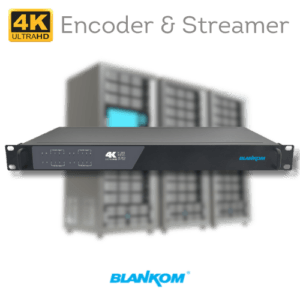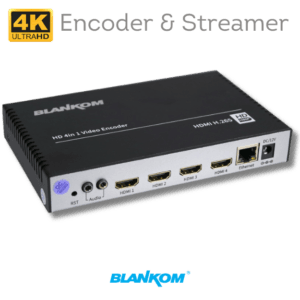

4K 60fps HDMI to IP Encoder & Streamer
Introducing the BLANKOM HDE-276 4K HDMI to IP Encoder, the ultimate solution for high-definition video streaming. This state-of-the-art HDMI encoder delivers excellent video quality, ensuring your broadcasts are sharp and vibrant.
At a glance
Key data, as supplied by engineering- HDMI, HDMI embedded audio, external analog stereo input by 3.5mm jacks
- GbE IP (up to 4 IP Streams), HDMI Loop-through output, USB3.0 interface and TF-Card (Micro-SD) for recording
- HDE-276 supports a maximum resolution of 4096x2160@60fps at the input, and up to a stream resolution of 4096x2160@60fps at the output. It works with stream protocols SRT / HTTP / HLS / FLV / RTSP / RTMP / RTMPS / UDP/RTP (Unicast/Multicast) and ONVIF. The HDE-276 is compatible with online live-streaming services, such as YouTube, Facebook, Ustream, and others.
Overview
Product description
Introducing the BLANKOM HDE-276 4K HDMI to IP Encoder, the ultimate solution for high-definition video streaming. This state-of-the-art HDMI encoder delivers excellent video quality, ensuring your broadcasts are sharp and vibrant. With its robust design, the HDE-276 provides stable operation and a robust build for demanding streaming applications.
Setting up the BLANKOM HDE-276 is a breeze, allowing you to get started quickly without any hassle. Its intuitive interface means you can focus on what matters most—creating and sharing exceptional content. Plus, with dedicated after-sales support from Germany, you can trust that expert assistance is just a call away.
Whether you’re in need of an IP streaming encoder for live events, an HDMI-input streamer for direct connections, or a versatile IP streamer encoder HDMI for various applications, the BLANKOM HDE-276 is your go-to solution. Elevate your streaming experience with this powerful HDMI encoder!
All BLANKOM encoders offer excellent image quality and stable system operation at an affordable price.
4Kp60 UHD H.265 (HEVC) and H.264 Encoder & Streamer with 4 Streams Output
4K Ultra High Definition (UHD) HDMI Streaming Encoder for live broadcasting platforms and Video-over-IP applications. Up to 3840*2160@60fps UHD resolution. Very stable operation on multicast distribution on local area networks. Suitable for video-over-IP applications through the internet. 4 IP output streams at the same time with different resolutions, e.g., for LAN, YouTube, Facebook, and Twitch simultaneously.
BLANKOM HDE-276 encoder serves the distribution of SD/HD and UHD TV/video content through IP networks in digital quality. The live video can be received by Internet media servers, by TV sets with IPTV set-top boxes, and on PCs and tablets with VLC Player.

BLANKOM HDE-276 4K HDMI Streaming Encoder
Features & capabilities
Features
BLANKOM HDE-276 IPTV encoder is designed for TV signal distribution in excellent quality over LAN and INTERNET.
The H.264 and H.265 (HEVC) compression technology features low latency and low bit rates for IPTV/OTT systems. The highly efficient encoding chips save bandwidth costs through all their resolution ranges.
Distribution of SD up to UHD TV channels through the IPTV/OTT network using state-of-the-art IP technology from almost any kind of video input.
Excellent video and audio quality.
High reliability. No regular service and maintenance is needed during operation.
From 1 input signal, 4 entirely different streams can be generated. The main stream can have up to 4K (2160p), the secondary streams up to 720p HD resolution.
On screen logo and text insertion. Through the HLS encoding feature, Android and iOS mobile devices are compatible.
The uni- and multicast streams can be assigned with DVB-conform table content to allow the integration into multiplexes of IP to DVB-Modulators.
The easy configuration is designed by a simple web interface application compatible with nearly every browser.
- H.265 / H.264 / MJPEG Encoder & IP Streamer combined
- HDMI compatible input and loop-through HDMI output, USB 3.0 interface, and (TF-) Micro-SD-Card slot for recording
- Stereo Audio Input
- 4 IP streams output
- Stable and effective embedded HiLinux OS
- HD Resolution 2160p60 (4Kp60), 2160p30 (4K), 1080p, 1080i, 720p and downscaling down to 176×144
- Low latency: > 200ms … 1200ms max., depending on configuration and load
- IP output: HTTP, RTSP, RTMP, RTMPS, UDP/RTP, FLV, ONVIF, HLS, SRT; unicast/multicast output.
- Distribution of Video camera, PC Monitor, dif. STB, DVD / Blu-ray player content over LAN, WAN or Internet
- Live stream broadcast, Digital signage, Video conferencing, RTSP support
- Video-over IP applications
- IPTV/OTT/Info-Channel applications
- Local IPTV on LAN applications, Corporate IPTV, Hotel IPTV, Campus IPTV, Education IPTV
- VLC and FFmpeg mode selectable
- VBR/CBR bitrate mode encoding
- Logo insertion (as *.bmp file) and text insertion feature on the main stream & on secondary streams
- Streams to Ustream, Atlas™, Wowza®, and Adobe® Flash® Servers, www.vmix.com conform to YouTube, Vimeo, X, Facebook, Twitch live broadcast platforms
- HLS encoding feature, Android and iOS mobile devices compatible
Front and rear panels
Front and Rear Panels

BLANKOM HDE-276 Encoder Streamer front

BLANKOM HDE-276 Encoder Streamer rear
Application examples
Application Example

Applications
Streamer for OTT platform providers for feeding the CDN with live video.
Streamer for multicast IPTV distribution on LAN.
Encoder for Video-over-IP applications. Suitable for use on Ka-Sat live feeds.
Distribution of Video camera, PC Monitor, dif. STB, DVD / Blu-ray player content over LAN, WAN or Internet
Live stream broadcast, Digital signage, Video conferencing, RTSP-ONVIF support
IPTV/OTT/Info-Channel applications
Local IPTV on LAN applications, Corporate IPTV, Hotel IPTV, Campus IPTV, Education IPTV
Technical specifications
Specifications are subject to change without prior noticeTechnical Specifications
Function H.265 (HEVC) & H.264 (AVC) Encoder and IP Streamer
INPUT
- HDMI compatible input and loop through HDMI output
- Input Resolution: 2160p, 1080p, 1080i, 720p and below
- Embedded audio from HDMI signal or stereo input by 3.5mm jack
- Recording over USB 3.0 interface and to a TF-Card (Micro-SD)
OUTPUT
- Simultaneous 4 different streams output per channel (mainstream and 3 substreams)
- Video data rate: 0.1 Mbps … 100 Mbps
- Output Resolution: 2160p, 1080p, 1080i, 720p and below (max. 2160p@60fps or 1080p@60 fps on main stream)
- Mainstream output resolution support: 4096×2160, 3840×2160, 1920×1080, 1680×1056, 1280×720, 1024×576, 850×480, 720×576, 720×540, 720×480, 720×404, 704×576, 640×480, 640×360, 608×448, 544×480, 480×480, 480×384, 480×360, 480×320, 480×272, 480×270, 400×320, 400×224, 352×480, 352×228, 320×256, 320×240, 320×180, 240×180, 176×144.
- Video fps 5-144 fps
- Recording over USB 3.0 interface or to the optional TF-Card (Micro-SD)
SYSTEM
- HiLinux OS
- TS protocols: HTTP(s), RTSP, RTMPs, UDP/RTP, FLV, ONVIF, HLS, SRT; unicast/multicast output.
- EDID/ GAMMUT Modes: BT2020, BT709, BT601
- ONVIF 2.x supported by RTSP: G711A
- Video encoder h.264 and h.265 (MPEG-4, AVC) high-profile Level 4.0 UHD 4K max. 60fps, MJPEG/JPEG baseline
- Data interface RJ45, 1000 Base-T Ethernet interface, management by web browser
- VLC and FFmpeg mode selectable
- Encoding Rate Control CBR/VBR
- GOP Structure IBBP Adv
- Pre-treatment de-interlacing, noise reduction, sharpening, and Y-C adjustments
- Audio Encoding AAC (normal, +,++), MP3, MP1L2, AC3 G711 stereo compatible
- Audio Bit-rate: 32k/48k/96k/128k/160k/192k, Data-rate: 12 kbps-640 kbps
- Audio Sampling Rates 44.1 kHz, 48.0 kHz
- Recording: TS-files to Micro-SD-Card or USB stick (high-speed versions recommended)
Supported Filesystems: NTFS, exFAT, FAT32 (FAT (16/32) are limited—check file size limits) - User interface: WEB GUI
- 4 logo and text insertions as transparent overlays
- Firmware upgrade support by WebIF
GENERAL
- DC 12V 2A power adapter
- Dimensions: 150 x 110 x 45 mm
- Weight: 500g
- Power consumption: 10W
Specifications are subject to change without prior notice.
Engineering questions
12 questions answered by the people who commission these unitsFAQ (Frequently Asked Questions)
What is the primary operational function of this compact BLANKOM 4K 60fps UHD HDMI IP Encoder?
This compact professional hardware unit is engineered to ingest high-bandwidth digital baseband signals from a 4K HDMI source (such as ultra-HD media players, medical imaging systems, high-end PC outputs, or UHD cameras) and compress the video/audio payloads in real time into optimized digital IP transport streams for live network broadcasting.
Does this specific 4K HDMI encoder support high frame rate processing for fast-action content?
Yes. The internal hardware encoding pipelines are fully optimized to process true 4K Ultra-HD resolutions up to 60 frames per second (2160p@60fps). This high frame rate capability ensures fluid motion rendering and exceptional sharpness, making it ideal for demanding environments like live sports distribution, digital signage grids, and high-action corporate events.
Which video compression codecs and encoding profiles are supported by the hardware core?
The advanced hardwre encoding core comprehensively supports next-generation H.265 (HEVC) as well as standard H.264 (AVC) video compression protocols. By leveraging high-efficiency H.265 algorithms, the device achieves a drastic reduction in required network transmission bandwidth while preserving the pristine, native color depth and clarity of the original 4K video source.
Which streaming protocols are natively supported by the egress network stage of the encoder?
Adhering strictly to professional B2B telecom specifications, the streamer engine supports an extensive selection of transport protocols. It natively delivers live streams over SRT (Secure Reliable Transport), HTTP, RTSP, RTMP, RTMPS, HLS, UDP, and RTP formats, allowing seamless integration with local network decoders, enterprise IPTV headends, and public Cloud CDNs.
How does the encoder ensure video stream stability and data protection over the public internet?
For remote site contribution or broadcasting over lossy public networks, the device fully utilizes its integrated SRT protocol layer. SRT applies smart ARQ (Auto Repeat Request) packet recovery mechanisms to counteract public internet network jitter and packet loss, while supporting industry-standard AES encryption to ensure strong end-to-end payload security.
Does this compact 4K encoder perform hardware-based video transcoding or scaling?
No. This device functions as a primary source encoder that compresses incoming uncompressed baseband HDMI signals into digital IP transport streams. However, its internal layout allows operators to configure independent sub-streams with adjusted lower resolutions and bitrates alongside the main 4K stream to accommodate low-bandwidth mobile viewing profiles.
What professional audio compression standards and configuration parameters are handled by the device?
The audio processing layer extracts digital audio directly from the embedded HDMI input signal. It natively supports standard broadcast compression formats—predominantly AAC, AAC+, AAC++, MP3, and MP2—giving headend engineers precise control over independent audio bitrates, volume gain adjustments, or stereo mode configurations.
How is remote configuration and real-time operational monitoring executed for this unit?
Core system provisioning, video input status tracking, encoding bitrates, and egress IP routing parameters are configured and monitored exclusively via an embedded WebGUI using a standard web browser over a dedicated, independent Ethernet management interface. This setup eliminates any complex software installations, providing an isolated and highly secure control plane.
What physical chassis form factor and power infrastructure are utilized by this compact encoder?
This encoder is built into a compact, space-conscious, and energy-efficient commercial enclosure, making it perfect for desktop placement, field contribution kits, or dense integration using custom rack trays. The unit relies on a highly reliable, internal single power supply framework optimized for steady 24/7/365 continuous operation and low thermal signature.
Can this encoder simultaneously generate multiple stream types to different destinations?
Yes. The advanced streaming core is capable of multi-stream broadcasting. It can ingest a single 4K HDMI source and simultaneously output independent stream configurations (such as an SRT stream to a remote master control room and a UDP multicast stream to local network decoders) with distinct bitrate allocations to perfectly adapt to diverse network topologies.
Does this compact encoder feature a local video loop-through or pass-through option for on-site monitoring?
Yes. The device incorporates a physical hardware layout that provides an HDMI compatible input paired with a local loop-through HDMI output port. This architecture enables broadcast engineers and AV operators to split the source video signal effortlessly, passing the uncompressed, low-latency 4K baseband preview feed straight to a local confidence monitor on-site while the main engine encodes and streams the payload over the network.
What localized data interfaces and recording capabilities are provided on the chassis?
To ensure mission-critical backup redundancy and external data ingestion, the chassis is provisioned with a high-speed USB 3.0 interface and a dedicated (TF) Micro-SD Card slot for local recording. These specialized hardware ports allow operators to attach external storage drives or high-capacity flash media to archive live streams directly at the edge, protecting your content against temporary network backhaul dropouts.
Downloads

Get a quote for the HDE-276
Tell us the source, the destination and the number of channels. We reply in writing with a configuration, part numbers and pricing — our engineers answer from the bench, so a written enquiry reaches the right person faster than a phone call.