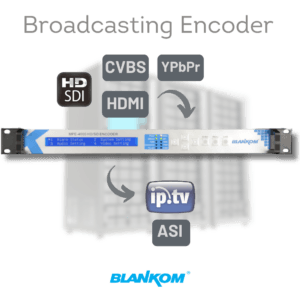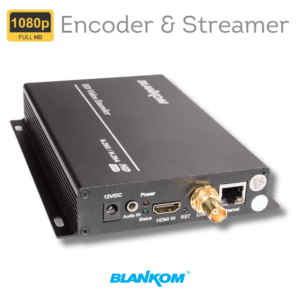

16 Channel, CVBS (PAL & NTSC) and HDMI to IP Encoder & Streamer
16-channel 1080p (2K) High Definition (HD) encoder & streamer for live broadcasting platforms and Video-over-IP applications. Up to 1920*1080@60fps Full-HD resolution.
At a glance
Key data, as supplied by engineering- 16x Analog CVBS (PAL & NTSC) and HDMI, embedded audio, external analog stereo input by 3.5mm jack
- 16x 100 Mbps IP (up to 2 IP Streams)
- ADE-16264 supports a maximum resolution of 1920x1080@60fps at each input, and at each output. It works with stream protocols HTTP / HLS / FLV / RTSP / RTMP / RTMPS / UDP/RTP (Unicast/Multicast) and ONVIF. The ADE-16264 is compatible with online live-streaming services, such as YouTube, Facebook, Ustream, and others.
Overview
Product description
16-channel 1080p (2K) High Definition (HD) encoder & streamer for live broadcasting platforms and Video-over-IP applications. Up to 1920*1080@60fps Full-HD resolution. Very stable operation on multicast distribution on local area networks. Suitable for video-over-IP application through the internet. 4 IP output streams per channel at the same time with different resolutions, e.g., for LAN, YouTube, Facebook, and Twitch simultaneously.
All BLANKOM encoders offer excellent image quality and stable system operation at an affordable price.
16 Channel Full HD H.264 Streaming Encoder with Analog (PAL, NTSC) and HDMI Input, 4 Streams Output per Channel
BLANKOM ADE-16264 streaming encoder serves the distribution of SD and HD TV/video content through IP networks in digital quality. The live video can be received by Internet media servers by TV sets with IPTV Set-Top Boxes on PCs and tablets with VLC Player.

BLANKOM ADE-16264 Full-HD IP Encoder Streamer
Features & capabilities
Features
BLANKOM ADE-16264 IPTV encoder is designed for TV signal distribution in excellent quality over LAN and INTERNET.
The H.264 compression technology features low latency and low bit rates for IPTV/OTT systems. The highly efficient encoding chips save bandwidth cost through all their resolution ranges.
Distribution of SD and HD TV channels through the IPTV/OTT network using state-of-the-art IP technology from almost any kind of video input.
Excellent video and audio quality.
High reliability. No regular service and maintenance are needed during operation.
From 1 input signal, 2 entirely different streams can be generated. The main stream can have up to Full HD (1080p), and the secondary streams up to 720p HD resolution.
On screen logo and text insertion. Through the HLS encoding feature, Android and iOS mobile devices are compatible.
The uni- and multicast streams can be assigned with DVB-conform table content to allow the integration into multiplexes of IP to DVB-Modulators.
The easy configuration is designed by a simple web interface application compatible with nearly every browser.
- H.264 Encoder & IP Streamer combined
- 16x Analog CVBS (PAL and NTSC) and HDMI compatible inputs
- Stereo audio input on each channel
- 2 IP streams output on each channel
- Modular structure
- Dual power supply with 1:1 redundancy
- Stable and effective embedded HiLinux OS
- HD Resolution 1080p60 (2Kp60), 1080i, 720p and scaling down to 176×144
- IP output: HTTP, RTSP, RTMP, RTMPS, UDP/RTP, FLV, ONVIF, HLS; unicast/multicast output.
- Low latency: 700 … 800 ms (800 ms in avg.) (RTMP)
- Distribution of video camera, PC monitor, dif. STB, DVD / Blu-ray player content over LAN, WAN, or Internet
- Live stream broadcast, digital signage, video conferencing, RTSP support
- Video-over-IP applications
- IPTV/OTT/Info-Channel applications
- Local IPTV on LAN applications, corporate IPTV, hotel IPTV, campus IPTV, education IPTV
- VLC and FFmpeg mode selectable
- VBR/CBR bitrate mode encoding
- Logo insertion (as *.bmp file) and text insertion feature on the main stream & on the secondary stream
- Streams to Ustream, Atlas™, Wowza®, and Adobe® Flash® Servers, www.vmix.com conform to YouTube, Vimeo, X, Facebook, Twitch live broadcast platforms
- HLS encoding feature, Android and iOS mobile devices compatible
System & application diagrams
Typical deploymentApplication Diagram

Application examples
Application Examples
B2B application examples showcasing how the 16-blade modular architecture and dual-power redundancy of the ADE-16264 solve large-scale video distribution requirements:
-
Carrier-Grade Central IPTV Headend Ingestion for Large Hotels and Resorts: Large-scale multi-building resort complexes or cruise ships require consolidating all video streaming infrastructure inside a secure central rack. By deploying the ADE-16264, engineers can ingest up to 16 high-definition satellite receivers or media players via HDMI/Analog into a single 3U cabinet space. The dual redundant industrial power supplies ensure that even if one power phase drops, the hotel’s 16 internal high-definition channels continue streaming H.264 UDP Multicast transport streams to guest room TVs without black-screen interruptions.
-
High-Density Multi-Camera Municipal and Courtroom Recording: Large municipal city halls or judicial complexes manage dozens of active cameras across multiple courtrooms and committee chambers simultaneously. The ADE-16264 acts as a centralized ingest hub, capturing 16 independent camera feeds in high-density H.264 format. Utilizing its 4-stream per channel capability, each courtroom blade can concurrently broadcast an RTMP feed to a public transparency portal, an RTSP feed to the main security monitoring wall, and separate high-bitrate master backup lines to an internal Network Video Recorder (NVR) for legal archiving compliance.
-
Centralized Enterprise Corporate Town Hall and Multi-Room Distribution: Multinational corporate headquarters often run independent video networks across different departments, training rooms, and executive boardrooms. By installing the ADE-16264 in the primary data center, the internal AV team routes 16 independent high-definition inputs directly into the 3U chassis. Selected blades can be optimized to stream secure low-latency SRT feeds over WAN to international branch offices, while other blades push standard RTMP/RTMPS streams to corporate cloud portals for remote employees watching via mobile devices.
-
Comprehensive University NOC Lecture Capture and Campus IPTV: In a university Network Operations Center (NOC), managing decentralized streaming hardware from 16 different campus lecture halls is highly inefficient. The high-density ADE-16264 centralizes this process by aggregating 16 independent HDMI camera and visualizer inputs into 1U/3U infrastructure. Each isolated module processes its own room feed into universally compatible H.264 multicast streams, allowing students anywhere on the local campus network to stream live educational feeds using standard open-source media players like VLC on any tablet or PC.
-
Teleport Contribution and DSNG Mobile Broadcasting Vans: Digital Satellite News Gathering (DSNG) trucks and satellite teleport stations operate under volatile conditions with zero tolerance for power failures. Broadcast crews install the rugged ADE-16264 inside their mobile rack units to handle up to 16 camera or production desk feeds simultaneously. Powered directly by the dual industrial power supply connected to independent backup generator circuits, the unit compresses the material into robust SRT and UDP transport streams, ensuring stable, uninterrupted contribution transmission back to the main studio headend under heavy environmental demands.
Technical specifications
Specifications are subject to change without prior noticeTechnical Specifications
Function: H.264 Encoder and IP Streamer, 16 Channels, Dual Power Supply
INPUT
- 16 analog CVBS (PAL & NTSC) and HDMI inputs
- Input Resolution 1080p, 1080i, 720p and below
- Separate audio input with level adjustment (3.5 mm L/R analog audio line in)
- Embedded audio from CVBS and HDMI signals or external audio can be selected
OUTPUT
- Simultaneous 2 different stream outputs per channel (main stream and secondary streams)
- Each stream can be H.264 encoded
- Video data rate: 0.1 Mbps ~ 32 Mbps
- Video frame rate: 5 ~ 60 fps
- Bit rate control: VBR, CBR
- Output Resolution: 1080p, 1080i, 720p and below (max 1080p@60fps on mainstream)
- Mainstream output resolution support: 1920×1080, 1680×1056, 1280×720, 1024×576, 850×480, 720×576, 720×540, 720×480, 720×404, 704×576, 640×480, 640×360, 608×448, 544×480, 480×480, 480×384, 480×360, 480×320, 480×272, 480×270, 400×320, 400×224, 352×480, 352×228, 320×256, 320×240, 320×180, 240×180, 176×144.
- Low latency: 700 … 800 ms (800 ms in avg.) (RTMP)
SYSTEM
- Protocol HTTP / HLS / FLV / RTSP / RTMP / RTMPS / UDP/ RTP (Unicast/Multicast) Stream Protocols and ONVIF
- Video encoder H.264 (MPEG-4, AVC) high, main, baseline profile, MJPEG/JPEG baseline
- Audio encoder AAC/AAC+/AAC++/MP3/MP2/AC3 G711
- Data interface RJ45, 100 Mbps Ethernet interface, control over web browser
- Rate control CBR/VBR
- GOP Structure IBBP Adv
- Pretreatment: De-interlacing, Noise Reduction, Sharpening
- Sampling rate Auto
- Audio Bitrate: 48K/64K/96K/128K/160K/192K
- Audio sampling precision: 24 bit
- Audio Data Rate: 12 kbps ~ 640 kbps
- User interface WEB GUI
- Logo (as *.bmp file) and text insertion feature on the main stream & on 2nd stream
- Firmware upgrade support
GENERAL
- Power supply 12V DC, 25A
- Dimensions: 19 inch, 3RU (483 × 300 × 133 mm)
- Weight: 6.5 kg
Specifications are subject to change without prior notice.
Engineering questions
10 questions answered by the people who commission these unitsFAQ (Frequently Asked Questions)
What is the primary structural design and purpose of the BLANKOM ADE-16264?
The BLANKOM ADE-16264 is a high-density, carrier-grade 16-channel IPTV encoding system housed in a permanent 3U 19-inch rackmount chassis. It is engineered to consolidate 16 independent ADE-264 motherboard modules into a single central chassis. Driven by a dedicated dual industrial power supply architecture, it serves as a robust micro-headend solution for telecommunication operators, high-density hospitality networks, and enterprise-grade multi-channel IP distribution.
How does the internal power distribution and redundancy architecture operate?
Sharing the same rugged chassis architecture as the HDE-16265 and SDE-16265 series, the ADE-16264 is equipped with dual (redundant) internal industrial-grade power supplies. Both power modules operate in a hot-standby, balanced configuration. If one power unit experiences an unexpected electrical failure, the secondary power supply instantly assumes the complete operational load without causing any voltage fluctuation, reboot sequence, or packet drop across the 16 encoder blades.
How are the 16 independent ADE-264 modules managed inside the 3U chassis?
The ADE-16264 utilizes a completely isolated multi-blade modular architecture. Each of the 16 internal motherboard modules functions as an independent hardware entity running its own standalone embedded Linux OS. Each blade features its own dedicated physical input interfaces, physical RJ45 network streaming ports, and unique IP addresses, allowing network engineers to independently configure, monitor, or reboot any single channel without interrupting the live streaming services of the other 15 channels.
What maximum resolution and frame rate does each encoder module support?
Each independent ADE-264 module natively supports video inputs and processing configurations up to 1920×1080 Full HD at 60 frames per second (1080p60). The internal system-on-chip (SoC) layout is backward compatible with 1080i, 720p, and standard definition formats, allowing for flexible multi-source analog and digital integration per slot.
Which video and audio compression standards are supported by this 16-channel system?
To ensure broad decoding compatibility across diverse legacy and modern client environments, the system utilizes universally accepted H.264/AVC (MPEG-4 Part 10) video compression. Audio payloads are compressed utilizing high-fidelity AAC-LC and MPEG-1 Layer II (MP2) standards, multiplexing the audio track directly into the outgoing digital IP transport container to preserve accurate lip-sync tracking.
How many independent IP output streams can each individual channel generate simultaneously?
Each independent ADE-264 motherboard blade incorporates an advanced multi-stream processing engine capable of generating up to 2 distinct, independent IP transport streams simultaneously from its single physical input source. This allows network operators to output a primary high-bitrate 1080p60 stream for primary display arrays while outputting up to three separate lower-bitrate sub-streams optimized for localized monitoring, mobile web proxies, or edge archival NVR loops.
Which IP network streaming protocols are natively supported by the ADE-16264?
Each internal encoder blade integrates a flexible multi-protocol streaming matrix. Every channel can distribute its processed transport streams simultaneously across various professional protocols, including UDP/RTP (Multicast and Unicast), SRT (Secure Reliable Transport), RTSP, HTTP, and RTMP/RTMPS, enabling parallel delivery to internal local IPTV networks and external public cloud CDNs.
Does the system support custom logo watermarks or text overlays per channel?
Yes, every individual encoding channel features its own integrated hardware OSD (On-Screen Display) engine. Administrators can independently overlay customized text lines, live system timestamps, channel watermarks, or corporate logos directly onto each video stream matrix via the respective web panel on the fly without causing processing latency or stream stuttering.
How is the ADE-16264 managed, and does it require external control software?
There are no mandatory third-party software or SNMP agent dependencies. Because each blade operates on its own embedded firmware, all individual encoding bitrates (CBR/VBR), resolution downscaling, protocol destinations, and audio mapping are managed completely remotely via an intuitive, responsive browser-based WebGUI (Web User Interface) accessed directly through each channel’s respective Ethernet management interface.
What makes a 3U rackmount system with redundant power superior to multiple compact portable units?
Deploying 16 individual portable encoders creates severe server room vulnerabilities, including massive power cable clutter, multiple external “power brick” failure points, uneven airflow, and high accidental disconnection risks. The ADE-16264 solves this by centralizing 16 enterprise channels into a standardized 3U 19-inch kabinet rack footprint. Its passive thermal ventilation design, coupled with hot-swappable dual industrial power supplies, provides the physical stability, clean cable dressing, and mission-critical hardware protection expected in professional telecom installations.
Downloads

Get a quote for the ADE-16264
Tell us the source, the destination and the number of channels. We reply in writing with a configuration, part numbers and pricing — our engineers answer from the bench, so a written enquiry reaches the right person faster than a phone call.