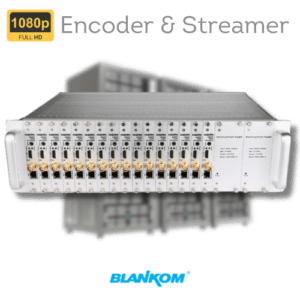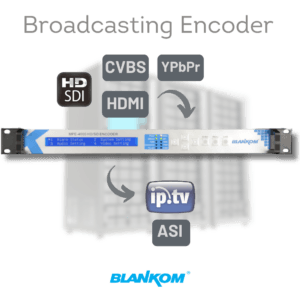

Analog CVBS (PAL & NTSC) and HDMI to IP Encoder & Streamer
IP Analog Streaming Encoder. 1080p (2K) High Definition (HD) encoder & streamer with Analog CVBS and HDMI inputs for live broadcasting platforms and Video-over-IP applications. Up to 1920*1080@60fps Full-HD resolution.
At a glance
Key data, as supplied by engineering- Analog CVBS (PAL & NTSC) and HDMI, embedded audio, external analog stereo input by 3.5mm jack
- 100 Mbps IP (up to 2 IP Streams)
- ADE-264B supports a maximum resolution of 1920x1080@60fps at the input, and at the output. It works with stream protocols HTTP / HLS / FLV / RTSP / RTMP / RTMPS / UDP/RTP (Unicast/Multicast) and ONVIF. The ADE-264B is compatible with online live-streaming services, such as YouTube, Facebook, Ustream, and others.
Overview
Product description
IP Analog Streaming Encoder. 1080p (2K) High Definition (HD) encoder & streamer with Analog CVBS and HDMI inputs for live broadcasting platforms and Video-over-IP applications. Up to 1920*1080@60fps Full-HD resolution. Very stable operation on multicast distribution on local area networks. Suitable for Video-over-IP application through the internet. 2 IP output streams at the same time with different resolutions, e.g. for LAN, YouTube, Facebook, Twitch simultaneously.
All BLANKOM encoders offer excellent image quality and stable system operation at an affordable price.
1080p60 Full-HD Streaming Encoder with Analog CVBS (PAL & NTSC) and HDMI Output
BLANKOM ADE-264B streaming encoder serves the distribution of SD and HD TV/video content through IP networks in digital quality. The live video can be received by Internet media servers by TV sets with IPTV Set-Top Boxes on PCs and tablets with VLC Player.

Features & capabilities
Features
BLANKOM ADE-264B IPTV encoder is designed for TV signal distribution in excellent quality over LAN and the INTERNET.
The Analog CVBS input can handle PAL and NTSC signals.
Both inputs can be encoded simultaneously.
The H.264 compression technology features low-latency and low bit rates for IPTV/OTT systems. The high-efficiency encoding chips save bandwidth costs through all its resolution ranges.
Distribution of SD and HD TV channels through the IPTV/OTT network using state-of-the-art IP technology from almost any kind of video input.
Excellent video and audio quality.
High reliability. No regular service and maintenance is needed during operation.
From 1 input signal, 2 entirely different streams can be generated. The main stream can have up to Full HD (1080p), the secondary streams can have up to 720p HD resolution.
Through the HLS encoding feature, Android and iOS mobile devices are compatible.
The uni- and multicast streams can be assigned with DVB-conform table content to allow the integration into multiplexes of IP to DVB-Modulators.
The easy configuration is designed by a simple web interface application compatible with nearly every browser.
- H.264 Encoder & IP Streamer combined
- Analog CVBS (PAL & NTSC) and HDMI compatible input
- HDMI embedded audio
- Simultaneous encoding of Analog CVBS and HDMI signals
- 2 IP streams output (Main stream and Sub stream)
- Stable and effective embedded HiLinux OS
- HD Resolution 1080p60 (2Kp60), 1080i, 720p and scaling down to 176×144
- IP output: HTTP, RTSP, RTMP, RTMPS, UDP/RTP, FLV, ONVIF, HLS; unicast/multicast output.
- Distribution of Video camera, PC Monitor, dif. STB, DVD / Blu-ray player content over LAN, WAN or Internet
- Live stream broadcast, Digital signage, Video conferencing, RTSP support
- Video-over IP applications
- IPTV/OTT/Info-Channel applications
- Local IPTV on LAN applications, Corporate IPTV, Hotel IPTV, Campus IPTV, Education IPTV
- VLC and FFmpeg mode selectable
- VBR/CBR bitrate mode encoding
- Logo insertion (as *.bmp file) and Text insertion feature on main stream & on secondary streams
- Streams to Ustream, Atlas™, Wowza®, and Adobe® Flash® Servers, www.vmix.com conform to YouTube, Vimeo, X, Facebook, Twitch live broadcast platforms
- HLS encoding feature, Android and iOS mobile devices compatible
Front and rear panels
Front and Back View
System & application diagrams
Typical deploymentApplication Diagram

Application examples
Application Examples
B2B application examples demonstrating how this hybrid dual-interface encoder solves specific integration challenges between legacy analog and modern digital ecosystems:
-
Digitizing Legacy CCTV Surveillance Arrays into Modern IPTV:
Many older corporate campuses, industrial complexes, and maritime ports maintain highly functional analog CCTV surveillance setups consisting of matrix switchers or older long-range analog cameras that output via CVBS. Instead of replacing the entire cable infrastructure, operators connect the master CVBS composite output into the hybrid BLANKOM encoder. The unit converts the analog PAL/NTSC matrix video into an H.265 RTSP or UDP Multicast stream, allowing security staff to view legacy camera feeds on modern digital IP video walls and computers.
-
Integrating Retro Hospital/Medical Diagnostic Displays into an IP Network:
Medical facilities often operate vintage, high-grade diagnostic equipment, such as older endoscopy systems or specialized microscopic video monitors that exclusively output analog CVBS signals via BNC or RCA connectors. By deploying this hybrid encoder, medical technicians can digitize these specialized video outputs along with patient room audio. The device encodes the stream into UDP Multicast format, broadcasting it securely over the hospital’s LAN to remote observation offices or lecture theaters without modifying the validated medical machinery.
-
Corporate Presentation Hub with Legacy VCR/DVD Archival Capabilities:
In corporate boardrooms or institutional archives, there is often a dual requirement: broadcasting live modern executive presentations via HDMI and digitizing older corporate history, training tapes, or archival footage from analog VHS VCR players or older DVD units outputting CVBS. This hybrid encoder serves as a versatile all-in-one ingest terminal. Staff can toggle the input mode via the WebGUI to easily switch between standard digital high-definition streaming and old-school analog tape archiving over the same IP infrastructure.
-
Maritime Vessel Entertainment and Radar Integration:
Commercial ships and passenger vessels frequently mix digital HDMI media servers with legacy analog marine components, such as older navigation camera feeds or composite TV tuners distributed around the vessel. This hybrid BLANKOM encoder allows ship engineers to connect the analog source during specific navigation segments or switch over to the digital HDMI input for streaming high-definition entertainment packages across the ship’s internal network using UDP Multicast streams, saving space and reducing overall hardware costs.
-
Local Government Council Chamber Micro-Headend Ingest:
Small municipalities or local community studios often have a mixed AV setup where the main chamber camera outputs a crisp digital HDMI feed, but older secondary media players or courtroom analog recording equipment output via composite CVBS lines. By utilizing this hybrid model, the local AV technician can handle both sources with a single piece of hardware. They can easily switch the active source via the remote WebGUI, streaming an RTMP/RTMPS feed directly to public internet portals or social media networks for transparent public reporting.
Technical specifications
Specifications are subject to change without prior noticeTechnical Specifications
Function: H.264 Encoder and IP Streamer (Streaming Encoder)
INPUT
- One HDMI input, one Analog CVBS (PAL and NTSC) input
- Input Resolution: 1080p, 1080i, 720p and below
- Embedded audio from HDMI signal and CVBS signal or external one audio can be selected
OUTPUT
- Simultaneous 2 different streams output (Main stream and Secondary stream)
- Each stream can be H.264/AVC High/ Main/ Baseline Profile MJPEG/ JPEG baseline encoded
- Video data rate: 0.1 Mbps ~ 32 Mbps
- Video frame rate: 5 ~ 60 fps
- Bit rate control: VBR, CBR
- Output Resolution: 1080p, 1080i, 720p and below (max 1080p@60fps on main stream)
- Mainstream output resolution support: 1920×1080, 1680×1056, 1280×720, 1024×576, 850×480, 720×576, 720×540, 720×480, 720×404, 704×576, 640×480, 640×360, 608×448, 544×480, 480×480, 480×384, 480×360, 480×320, 480×272, 480×270, 400×320, 400×224, 352×480, 352×228, 320×256, 320×240, 320×180, 240×180, 176×144.
SYSTEM
- Protocol HTTP / HLS / FLV / RTSP / RTMP / RTMPS / UDP/ RTP (Unicast/Multicast) Stream Protocols and ONVIF
- Video encoder H.264 (MPEG-4, AVC) high, main, baseline profile, MJPEG/JPEG baseline
- Audio encoder AAC/AAC+/AAC++/MP3/MP2/AC3 G711
- Data interface RJ45, 100 Mbps Ethernet interface, control over web browser
- Rate control CBR/VBR
- GOP Structure IBBP Adv
- Pretreatment deinterlacing, noise reduction, Sharpening
- Sampling rate Auto
- Audio Bit-rate 48K/64K/96K/128K/160K/192K
- Audio sampling precision: 24 bit
- Audio Data Rate 12 kbps ~ 640 kbps
- User interface WEB GUI
- Firmware upgrade support
GENERAL
- Power supply 12V DC, 1A
- Dimensions: 170 × 130 × 30 mm
- Weight 300g
- Consumption 6W
Specifications are subject to change without prior notice.
Engineering questions
10 questions answered by the people who commission these unitsFAQ (Frequently Asked Questions)
What is the primary operational capability of this hybrid BLANKOM encoder model?
This specialized BLANKOM encoder model is a hybrid dual-interface hardware appliance designed to bridge legacy analog infrastructures and modern digital video systems into a unified IP network. It features both a digital HDMI input and an analog CVBS (Composite Video, RCA/BNC) input on the same chassis, allowing operators to encode high-definition digital feeds or standard-definition analog signals into high-efficiency IP streams.
Can the encoder process and stream both the HDMI and CVBS inputs simultaneously?
No. This hardware appliance operates as a selectable single-channel hybrid encoder. It contains a high-performance system-on-chip (SoC) that allows you to connect both sources, but you must explicitly select via the management interface whether the active encoding source is the digital HDMI line or the analog CVBS line. It is designed to offer deployment flexibility, not simultaneous dual-channel ingest.
What maximum resolutions and encoding standards are supported for each input interface?
The resolution capabilities are strictly defined by the input signal parameters:
-
HDMI Input Mode: Supports digital resolutions up to 1920×1080 at 60 frames per second (1080p60 Full HD).
-
CVBS Input Mode: Supports analog standard-definition baseband video according to global broadcast criteria, specifically PAL (720×576) and NTSC (720×480). Both input lines are processed using high-efficiency H.265/HEVC and H.264/AVC compression standards.
How is audio handled across the different input configurations?
The device features dedicated audio extraction and routing matrix maps:
-
In HDMI Mode, it extracts digital audio directly from the embedded HDMI signal line.
-
In CVBS Mode, or when separate audio is required, operators utilize the physical 3.5mm stereo analog audio input jack or accompanying RCA line inputs to capture audio from older video players or soundboards, multiplexing it accurately into the outgoing transport stream container.
Which IP streaming protocols are supported natively by this model?
To ensure seamless integration with modern corporate networks, IPTV headends, and public cloud distribution layouts, the encoder integrates a multi-protocol streaming engine. It natively supports UDP/RTP (Multicast and Unicast), SRT (Secure Reliable Transport), HTTP, RTSP, and RTMP/RTMPS, enabling reliable delivery across local infrastructures and external CDNs.
Can the encoder generate sub-streams from the selected video source?
Yes, the device utilizes an optimized Dual-Stream encoding architecture. For the selected active input (whether HDMI or CVBS), it can simultaneously generate up to 2 independent IP streams (Main Stream and Sub Stream). This enables network managers to direct a full-bitrate stream to primary local decoders while pushing a lower-bitrate sub-stream to mobile screens or remote proxy servers.
Does the encoder include integrated On-Screen Display (OSD) overlay options?
Yes, a powerful internal hardware OSD engine is built into the firmware. Network administrators can overlay custom text lines, live system timestamps, corporate logos, or watermark graphics directly onto the video feed via the browser-based panel. The overlay parameters can be adjusted dynamically in real time without causing any packet loss or stream drops.
How is this hybrid encoder managed, and does it require external software?
The encoder operates on a highly stable, standalone embedded Linux OS that prevents system crashes and memory leaks. It does not feature SNMP support or third-party software dependencies. All configuration parameters—such as input interface switching, compression bitrates (CBR/VBR), and output IP protocol targets—are handled completely remotely via an intuitive, responsive browser-based WebGUI (Web User Interface) over its standard RJ45 Ethernet management port.
What is the reliability profile of the device under continuous 24/7/365 heavy-duty workloads?
Built inside a rugged, compact industrial metal chassis, the appliance features an advanced passive fanless thermal cooling design. By completely eliminating moving mechanical components—which represent the most common points of hardware wear and failure—thermal build-up is mitigated passively. This ensures a long Mean Time Between Failures (MTBF), making it suitable for uninterrupted 24/7/365 deployment in server rooms and remote industrial headends.
Does this model support video downscaling or aspect ratio conversion?
Yes. Through the WebGUI management interface, the internal video processing core allows for advanced video scaling adjustments. This is particularly useful when converting an analog 4:3 aspect ratio CVBS input into anamorphically formatted streams or downscaling a 1080p HDMI input to lower resolutions on the Sub Stream to strictly comply with localized network bandwidth limitations.
Downloads

Get a quote for the ADE-264B
Tell us the source, the destination and the number of channels. We reply in writing with a configuration, part numbers and pricing — our engineers answer from the bench, so a written enquiry reaches the right person faster than a phone call.