Professional Dual Audio Encoder
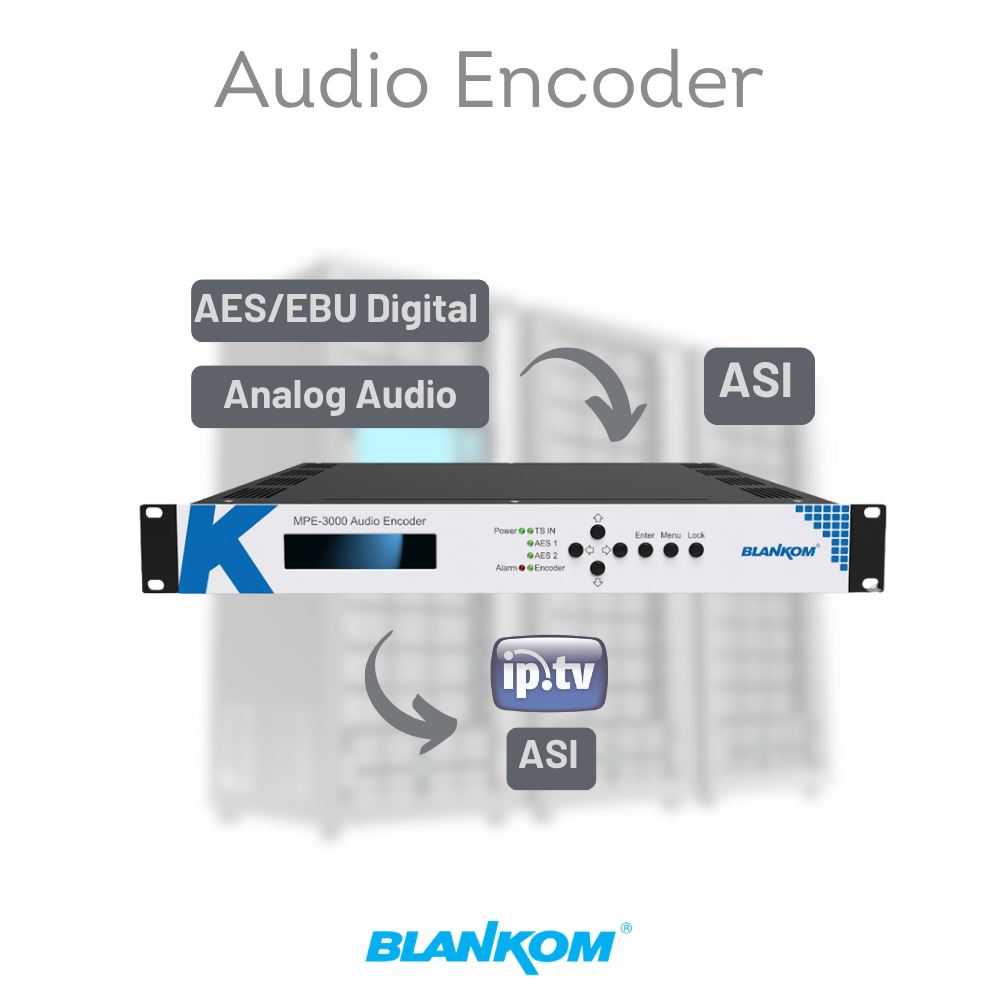
BLANKOM MPE-3000 is a professional audio encoder for broadcasters with dual analog balanced (XLR) and AES/EBU digital audio inputs and an ASI input. The unit has dual ASI outputs and a GigE IP output port over UDP/RTP protocol.
At a glance
Key data, as supplied by engineering- 2x Analog balanced audio (XLR interfaces)
- 2x AES/EBU digital audio (XLR interfaces)
- ASI input for multiplexing
- 2 independent ASI outputs, BNC interface (mirror out of MPTS/SPTS1/SPTS2)
- IP output over UDP/RTP protocol, GigE. Self-adaptive rj45 interface (unicast/multicast)
Overview
Product description
BLANKOM MPE-3000 is a professional audio encoder for broadcasters with dual analog balanced (XLR) and AES/EBU digital audio inputs and an ASI input.
The unit has dual ASI outputs and a GigE IP output port over UDP/RTP protocol.
Its various audio inputs support dual AES/EBU digital and dual analog stereo balanced (XLR) audio for universal professional needs.
A redundant power supply is optionally available.
Operation by using the front panel buttons or by the built-in comfortable web interface.
Broadcast-grade Dual Audio Encoder
The BLANKOM MPE-3000 is a professional dual audio encoding device equipped with two stereo channels. It is designed to support analog balanced audio and AES/EBU digital audio via XLR interfaces.
Furthermore, the unit features one ASI input for multiplexing, two independent ASI output interfaces, and one gigabit port for IP output. Its high compatibility and excellent encoding quality make this device widely used and highly reliable for integration into digital broadcasting systems.
Features & capabilities
- MPEG1 Layer 2 and AAC encoding
- Analog balanced (XLR) and AES/EBU digital audio inputs
- ASI input for multiplexing
- IP output over UDP/RTP
- Audio Encoding: Features 2 audio encoding channels.
- Format Support: MPEG1 Layer 2 and AAC encoding.
- Audio Modes: Supports left, right, and stereo encoding, noting that AAC is strictly for stereo.
- Gain Control: Adjustable audio gain from -12 to +12 dB.
- Input Flexibility: Supports analog balanced audio inputs and AES/EBU digital audio inputs.
- Multiplexing: Includes support for one ASI input for multiplexing purposes.
- Output Capabilities: Offers 2 independent ASI outputs via BNC interface, acting as a mirror out of MPTS/SPTS1/SPTS2.
- IP Streaming: IP output is delivered over UDP/RTP protocols, supporting both unicast and multicast.
- Management: Configuration is accessible via an LCD/keyboard interface or Web GUI management.
- Power Redundancy (option): Dual power supply with hot-plugging capability is available as an option
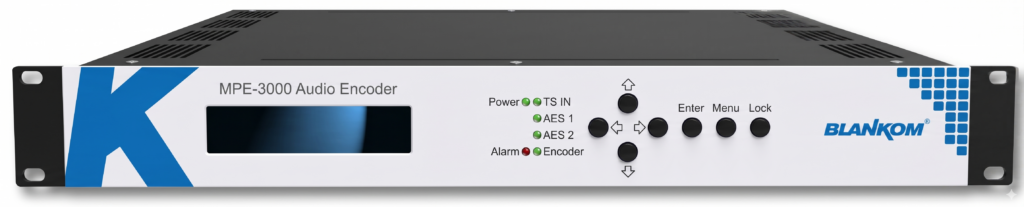
Front and rear panels
Front and Rear Panels of MPE-3000

System & application diagrams
Typical deploymentSystem Diagram
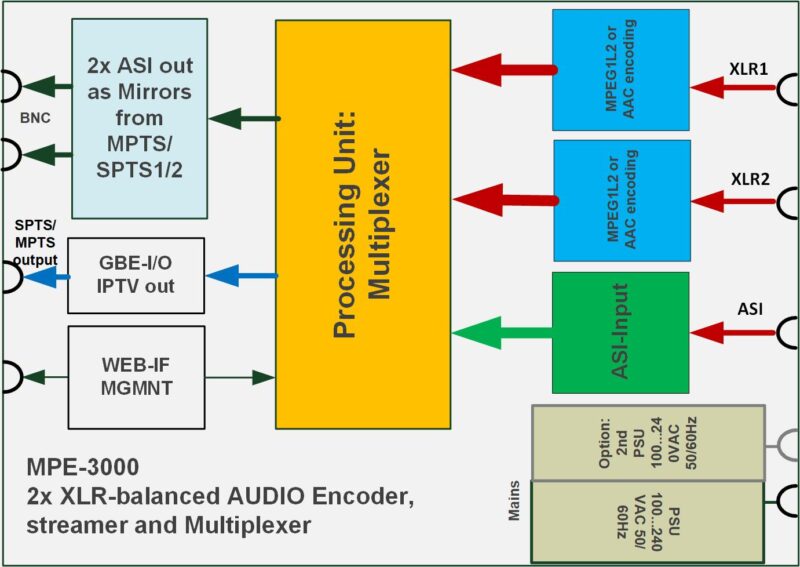
Application examples
Application Examples
B2B application examples showcasing how the professional audio architecture of the MPE-3000 solves complex acoustic distribution requirements:
-
Low-Latency Studio-to-Transmitter Link (STL) over Public Internet: A commercial FM radio station wants to route its master audio output from the city center studio to a high-altitude transmitter tower located miles away. The main mixer output is connected via balanced XLR cables to the MPE-3000. The device compresses the audio into high-quality HE-AAC format and streams it over a standard internet connection using the SRT protocol. At the mountain tower site, a corresponding BLANKOM IP decoder extracts the stream and feeds the FM transmitter cleanly, bypassing expensive leased telecom lines.
-
Centralized In-Store Radio Distribution for Retail Chains: A large supermarket or retail brand operates its own curated in-store music and announcement channel from a central headquarters. The live announcer microphone and playout system are routed into the MPE-3000. The encoder converts the feed into an IP Multicast UDP stream distributed across the brand’s private corporate WAN. Hundreds of branch locations receive the stream via local low-cost network media players, ensuring synchronized background music and real-time marketing promotions across all stores simultaneously.
-
Global Syndicated Radio Network Contribution Links: A national radio network syndicates its morning talk show to dozens of regional affiliate stations across the country. The master studio feed is encoded by the MPE-3000 into an RTMP/RTMPS or SRT stream and pushed directly to a cloud-based media proxy server. The regional affiliate stations connect to this central cloud link to pull the live feed, seamlessly inserting the syndicated audio network stream into their local transmitter playout desks in real time.
-
Houses of Worship Multi-Zone Audio and Overflow Hall Streaming: Large cathedrals or modern houses of worship require distributing crystal-clear sermon audio to overflow tents, separate building wings, and online streaming portals simultaneously. The main altar mixing soundboard is plugged into the MPE-3000 via digital AES/EBU interfaces. The encoder distributes an RTSP/UDP multicast stream over the internal IT network to local active IP speakers in overflow zones, while concurrently pushing an optimized stream to public audio CDN platforms for remote listeners.
-
Sports Stadium Commentary and Press Box Turnaround: During live major league stadium events, multiple sports commentary desks generate high-quality analog audio feeds that must be routed instantly to the master broadcast truck outside. By deploying the MPE-3000 directly inside the press box rack cabinet, technicians capture the uncompressed XLR commentary feeds. The unit digitizes and encodes the audio, distributing low-latency UDP transport streams over the stadium’s internal fiber optic IP grid straight to the OB van production desks with high signal clarity and very low ambient interference.
Technical specifications
Specifications are subject to change without prior noticeTechnical Specifications
Function: Broadcast-grade Dual Audio Encoder
Input Interfaces
- Analog audio input: 2x Analog balanced audio, XLR interfaces
- Digital audio input: 2x AES/EBU digital audio, XLR interface
- ASI input: 1x ASI input, BNC interface
Output Interfaces
- ASI output: 2x independent ASI outputs, BNC interface (Mirror out of MPTS/SPTS1/SPTS2)
- IP output: IP output over UDP/RTP protocol, 100M/1000M Self-adaptive rj45 interface (unicast/multicast)
Encoding Processing
- Audio formats: MPEG1 Layer 2, AAC
- Sample rate: 48 kHz
- Sample accuracy: 16 bit
- Bit-rate: 64/96/128/192/256/320/384 kbps
- Soundtrack: left, right, stereo (AAC is only for stereo)
Multiplexing
- Maximum PID number: 64
System & General
- Management: Web-server management, LCD + control buttons (English language).
- Power supply: Single power supply standard; dual power supply optional
- Power requirements: AC 110V±10% or AC 220V±10%, 50/60Hz
- Power consumption: <15W.
- Temperature range: 0~45°C (operation)
- Dimensions: 482 x 350 x 44mm
- Weight: Approx. 3.2 kg.
Specifications are subject to change without prior notice.
Ordering guide
Exact part numbers for the quotationOrdering guide
Engineering questions
10 questions answered by the people who commission these unitsFAQ (Frequently Asked Questions)
What is the primary operational purpose of the BLANKOM MPE-3000?
The BLANKOM MPE-3000 is a professional broadcast-grade hardware appliance designed exclusively for high-fidelity audio encoding and IP streaming. It ingests analog or digital audio feeds from professional studio mixers, microphone arrays, or playout systems and converts them into highly optimized, low-latency IP transport streams for distribution across local area networks (LAN), wide-area networks (WAN), or internet links.
What type of physical audio input interfaces are integrated into the MPE-3000 chassis?
To comply with professional broadcast and studio standards, the MPE-3000 features premium physical XLR balanced analog audio inputs alongside digital AES/EBU (XLR) interfaces. This engineering layout ensures high noise immunity, prevents ground loops, and eliminates signal degradation over long cable runs between the main studio mixing console and the transmission rack.
Which audio compression standards and bitrates does the MPE-3000 support?
The MPE-3000 integrates a dedicated hardware DSP tailored for high-fidelity acoustic processing. It supports industry-standard compression algorithms including MPEG-1 Layer II (MP2), AAC-LC, HE-AAC, and uncompressed Linear PCM parameters for ultra-low-latency applications. Operators can precisely configure encoding bitrates from low-bandwidth speech profiles up to high-density master-grade streams.
What network streaming protocols are supported natively by the MPE-3000?
To ensure smooth integration with radio broadcast transmitters, modern IP networks, and cloud CDN architectures, the MPE-3000 incorporates a multi-protocol streaming engine. It supports UDP/RTP (Multicast and Unicast), SRT (Secure Reliable Transport), RTSP, and RTMP/RTMPS, enabling rock-solid point-to-point and point-to-multipoint audio distribution.
Can the MPE-3000 function as a Studio-to-Transmitter Link (STL) for radio stations?
Yes. Due to its hardware-isolated processing matrix and native support for the SRT (Secure Reliable Transport) protocol, the MPE-3000 is optimized to act as an IP-based Studio-to-Transmitter Link (STL). It encapsulates the master studio audio mix and streams it securely over standard internet links to remote terrestrial FM or DAB+ transmitter sites with minimal latency and high resilience against packet loss.
How does the encoder handle signal recovery during unexpected network jitter?
The MPE-3000 incorporates an advanced internal jitter buffer and error-correction algorithms (such as FEC and SRT ARQ retry mechanisms). When streaming over volatile public internet connections or long-distance WAN links, the device dynamically manages incoming packet variations, preventing acoustic dropouts, pops, or synchronization phase shifts.
Does the MPE-3000 allow for independent volume and gain control adjustment?
Yes, via the remote configuration architecture, audio engineers can explicitly adjust input gain parameters and volume levels independently for the left and right audio channels. This software alignment ensures optimal modulation headroom and prevents clipping or distortion before the analog-to-digital conversion stage.
How is the MPE-3000 managed, and does it require dedicated client software?
The appliance operates on a stable, deeply hardened embedded Linux OS and requires no external software dependencies. All system parameters—including input interface selection (Analog XLR vs. AES/EBU), compression profiles, target IP paths, and real-time audio level meters (VU meters)—are managed completely remotely via an intuitive, responsive browser-based WebGUI (Web User Interface) over a dedicated RJ45 management port.
What is the structural reliability profile of the MPE-3000 under constant 24/7/365 loads?
Housed in a ruggedized, standard 1U 19-inch rackmount chassis with an integrated internal industrial power supply, the MPE-3000 utilizes an advanced passive fanless cooling layout. By eliminating moving mechanical parts—which represent the primary failure point in continuous server environment layouts—the device runs with exceptional thermal stability, delivering a long Mean Time Between Failures (MTBF) for constant 24/7/365 radio headend deployment.
Can the MPE-3000 output multiple independent IP streams simultaneously?
Yes, the internal stream-generation engine can distribute the processed audio payload into multiple destination IP targets concurrently. This allows an engineering team to broadcast a high-bitrate primary feed to the main transmitter station while simultaneously pushing optimized sub-streams to cloud-based internet radio streaming proxies or backup archiving recorders.
Downloads
Downloads, Links

Get a quote for the MPE-3000
Tell us the source, the destination and the number of channels. We reply in writing with a configuration, part numbers and pricing — our engineers answer from the bench, so a written enquiry reaches the right person faster than a phone call.